6 Ways to Spot a Witch (in 17th Century Scotland)
First off, let me clarify: there was no witch hunt. There were only witch trials.
Who Cares? (About Witches)
In particular, these two important guys.
John Calvin in 1560
Scotland’s own Reformation established Calvinism as the nation’s religion. Instead of a liberal reform (like Martin Luther’s), this one tightened up the rules.
But make no mistake, the reform was still very much about consolidation of power.
To the scholars, it was a huge shift in theology, but to the regular person, a change in denomination did not change very much about their day-to-day life. Especially in the rural areas where there was only one actual church building, and no one could read anyway.
The most relevant distinction of Presbyterianism to the Witch Trials of the 17th century is predestination. Or, the idea that Everything Happens for a Reason.
And the Reason, in this context, is God.
Specifically, everything is either a reward for goodness, or a punishment for badness.
So, if you didn’t do anything bad, but something bad happened to you, that was the work of witches.
King James VI & I in 1589
As you may know, the King at this time was considered to be above fault. That meant he could do no wrong. That meant if something bad happened to him, then it was witches, because it could not possibly be a punishment.
So, King James VI of Scotland went to marry his fourteen-year-old cousin, Anne of Denmark. To get to the British isles, Anne had to travel across the North Sea—a notoriously inhospitable body of water. Her ship went missing for days until it returned to its original port. King James went to collect her. He, too, was caught up in storms the whole way there, and then again on their way back. King James then blamed “contrary winds,” and he was convinced that because he had never done anything wrong in his life, and he ruled by divine right, those winds were summoned by witches to sink their ships. After that, he became somewhat obsessed with witches.
By that, I mean, he had no theological training, yet he published several treatises on witchcraft, one of witch is named Daemonologie.
People in both Denmark and Scotland were accused of summoning the winds that tried to sink the royal ships. The North Berwick witch trials that ensued were the first major trials of the witch panic.
A Quick Back-Track... 1486
Hammer of Witches or Malleus Maleficarum
German Dominican friars Jakob Sprenger and Heinrick Kramer published the Malleus Maleficarum, or The Hammer of Witches, which worked as a handbook on rooting out and destroying both witches and members of pagan religions. Pope Innocent VIII agreed to their ideas in principle, writing out a Papal Bull in support. When he saw the handbook in fact, the pope then refused to sign the bull. It was and is an unquestionably misogynistic but especially ableist process for weeding out and destroying anyone who was in any way different.
Try to muscle through it now, and the circles you’ll have to run around a straw man will wear you out within the first pages. The Pope’s preemptive blessing alone, however, granted the Hammer status as a legal document, and it detailed many how-to methods of inventive torture to procure a necessary confession from an accused witch.
This is the handbook that people used to torture witches up until 1653.
Here are a few favored methods of torture:
1. The Branks, AKA Scolds’ Bridle

Image taken by the author at the Scottish Witchcraft Museum.
As you can see in this photo I took at Leonard Low’s Museum of Scottish Witchcraft, the woman—well, usually a woman. I read somewhere 80% of people accused of witchcraft were women. At least, the accusations that were recorded by the Kirk Sessions—oh, yes, these trials would have happened in the church by the way.
The woman would have worn a rough cloth, and likely shaved of her hair. This iron headpiece fit over the head to the shoulders, and most of them had an actual bit as well, or piece that went into the witch’s mouth. The minister would lead the accused witch by carrying this ball and chain, and if he gave it a good yank, there went your front teeth.
If you didn’t look like a witch before, you would by the time you reached the horning (announcement of your crimes) at the kirk door!
2. The Thumbscrews
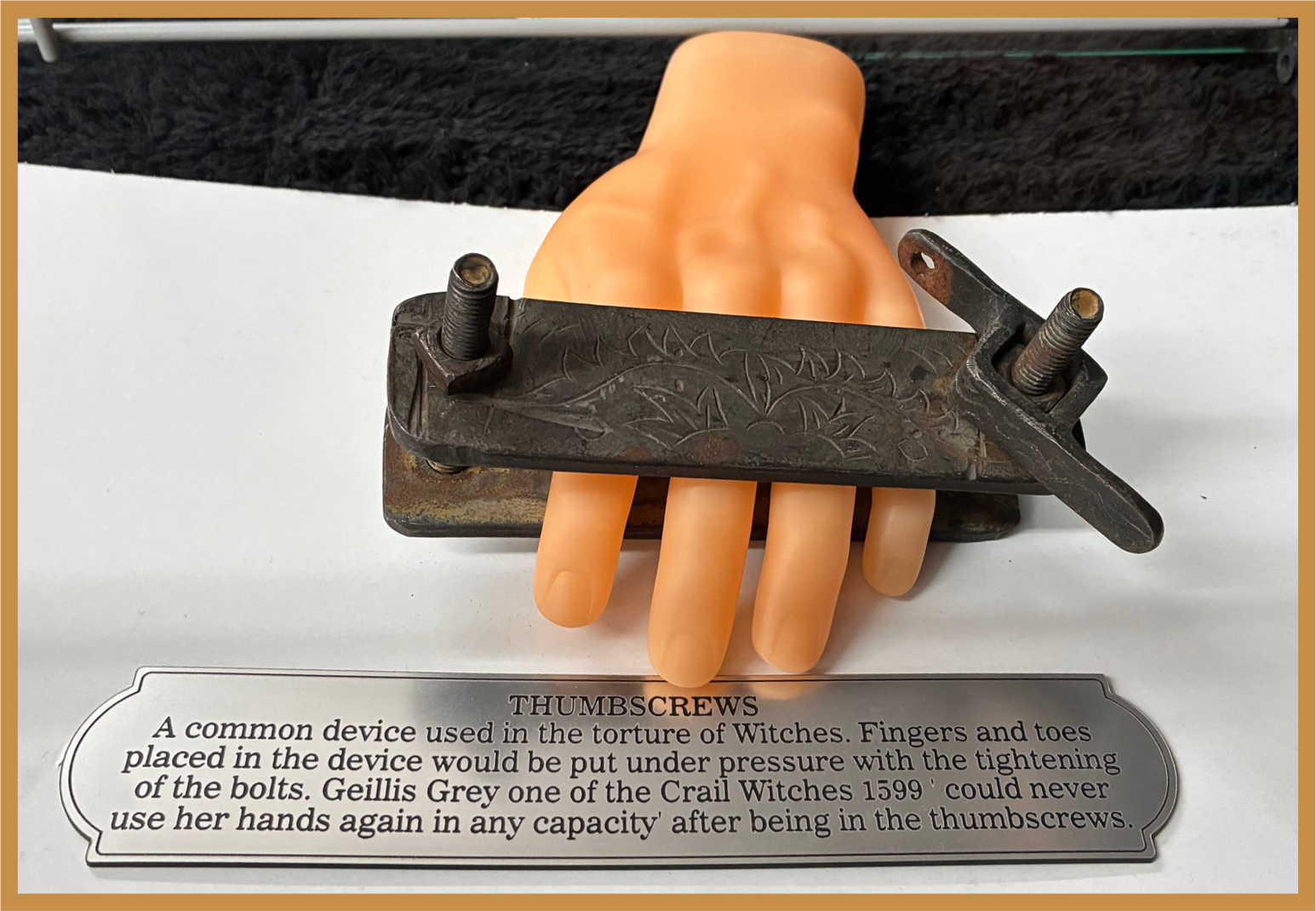
Image taken by the author at the Scottish Witchcraft Museum.
This is what it sounds like: the accused witch’s thumbs were sandwiched between two iron pieces, and the screws were tightened till she confessed.
You remember the witches’ lines from Macbeth? “By the pricking of my thumbs / something wicked this way comes?” It’s from this device.
As the plaque says, this torture would render a woman’s hands completely unusable, which was a real problem in 17th century Scotland, when two of women’s key jobs were spinning and weaving.
3. The Witches’ Goad

Image taken by the author at the Scottish Witchcraft Museum.
This device was used specifically on the St. Monans Witch Maggie Morgan. The plaque below the artifact says it’s essentially a hairbrush made of nails that she was beaten with to "appease the Earl of Anstruther" after his son cast her aside.
4. The Wirreit
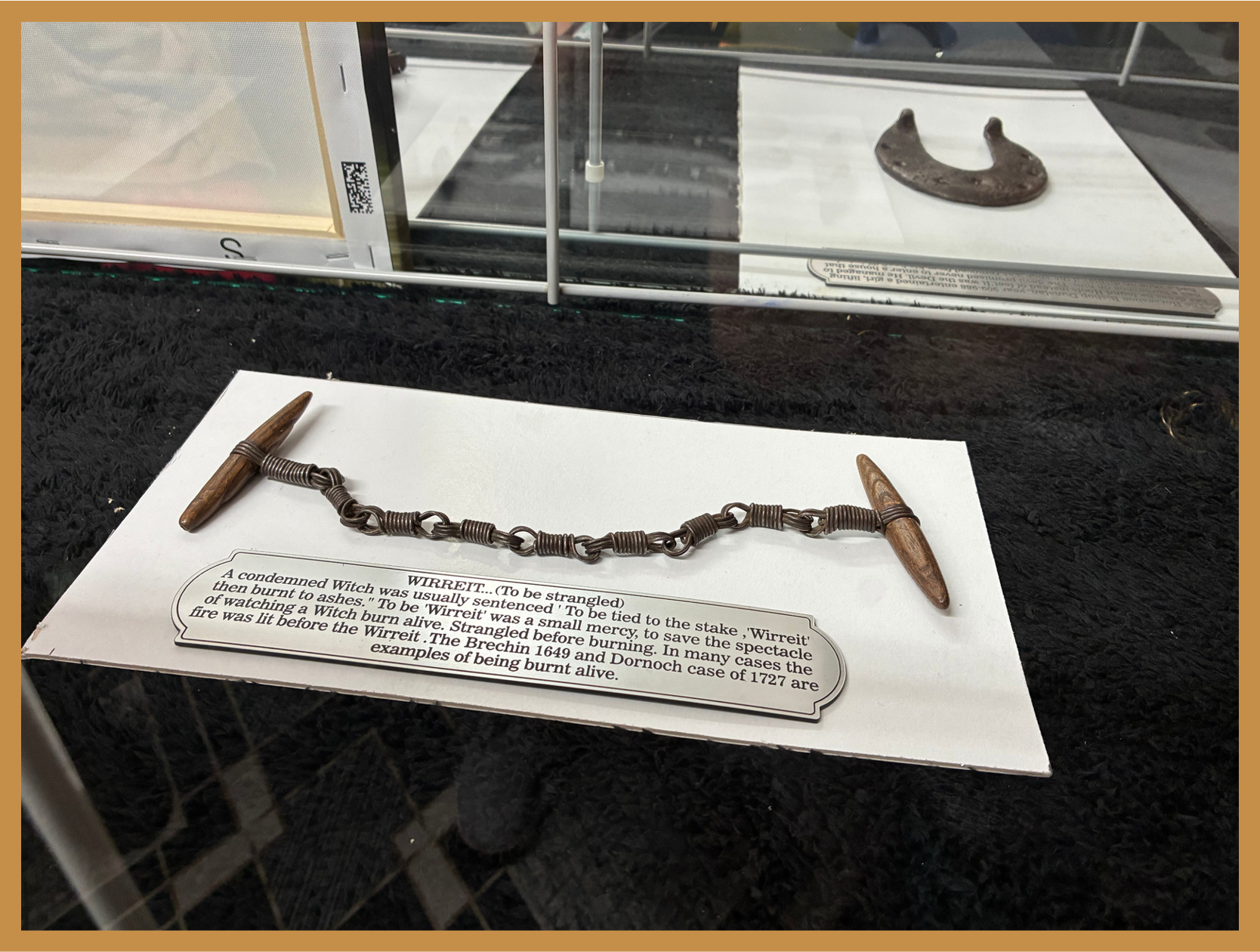
Image taken by the author at the Scottish Witchcraft Museum.
(Pronounced WIRR-it. With the Scottish “R.”) The wirreit was actually a mercy-kill device, so, kind of the opposite of a torture device.
Hear me out: because this is Scotland, and witchcraft is viewed as heresy, which is viewed as treason, by the transitive property, there’s only one sentence for a witchcraft conviction: that’s death.
The typical way of executing a witch--in very brief, was to garrot her with this device and then burn the body so that Satan could not resurrect it to do its bidding later.
Which meant that on the day of judgement, there was no body for God to resurrect, either. So the woman was condemned in the next life as well as this one.
But all the shoot-from-the-hip torture came mostly to an end in 1649 when...
1649 Good-by, King Charles I
Charles I lost the Second English Civil War. To oversimplify egregiously, King Charles I was put on trial by the Parliamentarian High Court of Justice, convicted for High Treason, and beheaded. The King was. Convicted of High Treason. Okay.
This was the Interregnum. The Commonwealth was established.
1653 Hello, Lord Protectorate Oliver Cromwell
The Protectorate was established, with Lord Protector Oliver Cromwell leading the country as a military dictator instead of a monarch
Cromwell hated fun. For example. he outlawed plays, and in Scotland, he made it illegal to celebrate Christmas. (That’s why NYE, or Hogmanay, is such a rager there.) FYI, It was illegal to celebrate Christmas until the 1950s.
He also outlawed all this witchcraft torture. He said that individual kirks could no longer hold a trial for witchcraft without permission from the Privy Council in Edinburgh.
But! That didn’t mean it wasn’t still happening, they just had to get creative.
1660 Hello, King Charles II
People saw their opportunity in 1660. Charles II was restored to the throne of England. The independent Scottish Parliament and Kirk were re-established under control of the Crown.
The government is still trying to get their feet up under them, so whenever one of those petitions to try a witch came in, the answer was usually...
Work it out among yourselves.
But, they were much more likely to say this if the petition already stated a confession for witchcraft.
And you couldn’t get the confession under duress, either--that means no torture devices.
5. Waking the Witch
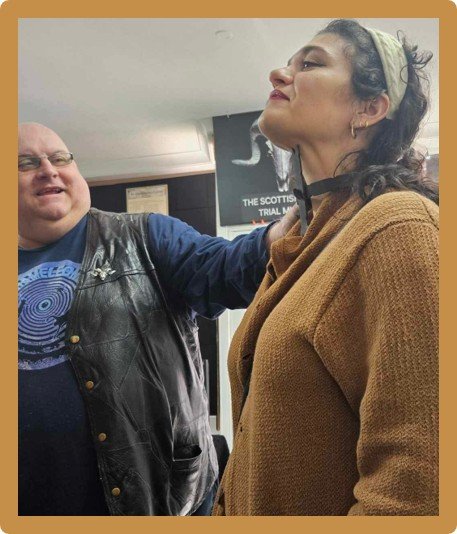
Image taken by the author (of the author, with owner Leonard Low) at the Scottish Witchcraft Museum.
The fifth way of spotting a witch in 17th century Scotland was called “waking the witch,” otherwise known as one majorly illegal form of torture and interrogation… sleep deprivation.
(Outlawed in the US in 2009, fyi.)
Iykyk, sleep deprivation actually interferes with interrogations rather than helps them because after (I think) 24 hours without sleep, you start to hallucinate.
And if we talk for long enough about the devil, I’m a see him. And then you have your confession.
The device I’m wearing in the photo above does not have a name as far as I know, but the top end of that iron necklace is spiked. It would have kept me from nodding off, for sure.
6. Pricking

Image taken by the author at the Scottish Witchcraft Museum.
The sixth way to spot a witch in 17th century Scotland is Witch Pricking.
So, something else in the Bible fanfiction known as the Malleus Maleficarum is that WHEN the witch CONSENTED to be the Devil’s Bride, she had a Satanic Baptism IN WHICH they consummated the union, usually with a huge party at midnight at a bonfire with bagpipes and drums and whisky and the whole nine yards (get it? It’s a kilt joke).
During this consummation, the Devil grabbed the witch. The place where he grabbed her was known as the Devil’s Mark.
Sometimes you could see it, like maybe it was a mole or a birthmark or a scar (remember this is 17th century UK, so everyone had plenty of those from pox alone).
Sometimes it was cold to the touch.
But it was always numb.
The witch pricker would find the spot where you couldn’t feel this brodder, or pricker. (This is about 5 inches long by the way.)
So, this is either torture, and you eventually cave. Or, they were very skilled in acupuncture. Or, they found legit scars where you couldn’t feel it.
And the most important thing to remember is that no one didn’t believe in this logic. Or at least they couldn’t say so, because then they’d be a witch by association.
The saddest part of my research were the instances in which women were like, “Call the witch pricker. Do it. I’ll pay him myself because I’m not a witch.”
(They knew they would likely die from these wounds, by the way, but it was better to die in this life alone than be punished eternally by the sentence of burning the body.)
And the witch prickers find the Devil’s Mark (because they were paid by the conviction), and then the woman is like, “Yeah, I guess I’m a witch then. And the Devil... I guess he came to me in the form of my husband, since I’ve never been with anyone else.”
Now you have a confession, you get your permission, I get executed, and all my moveable goods revert to… the people who accused me and the people who helped with the trial.
Here’s the Survey of Scottish Witchcraft, if you’re interested in seeing actual digitized records from the period: https://witches.hca.ed.ac.uk/
And if you like this kind of thing, be sure to follow me here.
If this article stuck with you, then you might also enjoy these….
--This Is What Happened at a Typical Scottish Witch Trial
—The "Real" Witches of Macbeth
—What Was FRANKENSTEIN Based On?
—How Jenny Geddes Sparked a Rebellion in 17th-Century Scotland
