What Is Boots Riley’s Film, I LOVE BOOSTERS about? Costume design articulates the ethics of creativity and AI. Let me explain.
When a film undertakes as much plot as Boots Riley’s new film, I Love Boosters, a reviewer has to either choose one very poignant element and go deep, or go wide and explain the entire thing… and at that point, the reader may as well watch the film yourself.
Needless to say, I’m going deep.
To go deep, though, I will have to include plot spoilers, so if you haven’t seen I Love Boosters yet, and you don’t want the ending spoiled, bookmark this article, and then come back.
What is I Love Boosters about?
“What is it about?” is a great question for this film—it bites off a lot. I Love Boosters is Marx’s dialectical materialism manifested as a class war about intellectual property, labor conditions, and the fashion industry. The costumes are the most important point of I Love Boosters because the form doesn’t just imitate the content here: the form is the content.
What I want to talk to you about are the individual costume moments that best embody that concept.
So here’s a quick summary of relevant plot points.
Synopsis
The Velvet Gang steals designer clothes from retail stores—mainly the monochromatic store METRO, operated by Christie Smith (Demi Moore). The boosters re-sell the clothes at pop-ups to people who could not otherwise afford to shop there. They turn a profit, of course. We soon learn that Christie has stolen a design from one of the Velvet Gang, Corvette (Keke Palmer), which naturally reframes the narrative as stealing back.
The women are all in disguises when they commit these robberies, by the way. Disguises that would only blend in to a Boots Riley aesthetic.
Costume designer Shirley Kurata told W Magazine, “The whole point was that they couldn’t get recognized, so they had to have disguises….But we wanted to make sure every outfit was heightened.”

Courtesy of NEON
Then, when the Velvet Gang goes to rob a new METRO, they discover it’s already been hit. And the store is completely empty.
[SERIOUSLY, IF YOU DON’T WANT THIS MOVIE SPOILED, STOP READING HERE.]
One of the employees (Eiza González) steals the security footage and reveals Jianhu (Poppy Liu) with what Corvette calls “a magic bag,” sucking every article of clothing off their hangers and into a Mary-Poppins-like sack. It’s not a magic bag: it’s a teleporter.
In fact, Jianhu teleported to the Bay from a garment manufacturing factory—read, sweatshop—in Qingdao, China.
But it’s not just a teleporter, either. It also has the postmodern settings “situational accelerator” and “deconstructor.”
Let me stop the plot summary here, because that’s enough for you to keep in mind for me and my argument… although, the movie does go off the rails in wildly unpredictable ways, including everything from stop-motion animation to a Looney-Tunes-like soundtrack to sex demons.
So, we have several layers of exploitation to unpack
It’s interesting: in the past few years I’ve been consuming more content that defends the designers’ creations as intellectual property, like Kirstin Chin’s novel Counterfeit, for example, which follows a woman who traffics copies of designer handbags. Or, how dupes and knock-offs might be more affordable, but they’re unethical because the original artist does not profit from their design. Or, how to thrift second-hand clothes at a fraction of their retail. All of these takes are vindicated and important, and then there’s the whole argument about feeding art to AI so you can have a generated image of your cat in a suit of armor….
Still, in my orbit, very few people are focusing on the theft of IP by designers, and we only hear about cultural appropriation when celebrities do it.
I mean, I as an author hear about theft of intellectual property a lot, especially when AI software uses creative writing to “learn” how to be “creative.”
Postmodernist Setting 1: The Situational Accelerator
To me, the “situational accelerator” aimed at designer clothing was such a visual metaphor for that theft—the one that people are still somehow defending as not stealing (you must cite your sources, hello), that I have to identify the elements here.
For a little more context, while Christie Smith might not be designing her own clothes, she was a mathematical prodigy who designed the teleporter, et al, that uses other people’s designs to make “new” ones.
It was an… interesting writing choice to have actual fledgling designer, Corvette, obsessed with fashions that are, possibly, artificially generated.
Do you want your designs automated, or would you rather be an individual? (This should be a rhetorical question)
Creating the software that steals and synthesizes is not the same as creating the art
In case it was unclear, I do not think that because Christie Smith developed the technology of the teleporter, et al, she can be fairly called the designer of the things it spits out. I mean, shit, she can’t even identify turquoise when it’s staring her in the face.

Courtesy of NEON
According to costume designer for I Love Boosters, Shirley Kurata, though, “Turquoise is funny because it’s a really difficult color to find — it could easily veer into being too green or too blue.”
The situational accelerator, when applied to clothes, essentially takes the job of the designer and automates it.
Don’t worry: I Love Boosters is all real art
Of course, the costumes depicted in the film are true creations—it satirizes that thought to an outrageous degree. Costume designer Shirley Kurata told LA Weekly, “There were times when, once the set was built, I would bring outfits to the sets, hold them up, and take photos to see what worked and what didn’t. It was a lot of costume house pulls and a lot of thrifting. It was fall/winter at that time, so it was hard to find any color. We also shopped online. None of the talent or the background was computer-generated; the cast was all dressed in the original colors.”
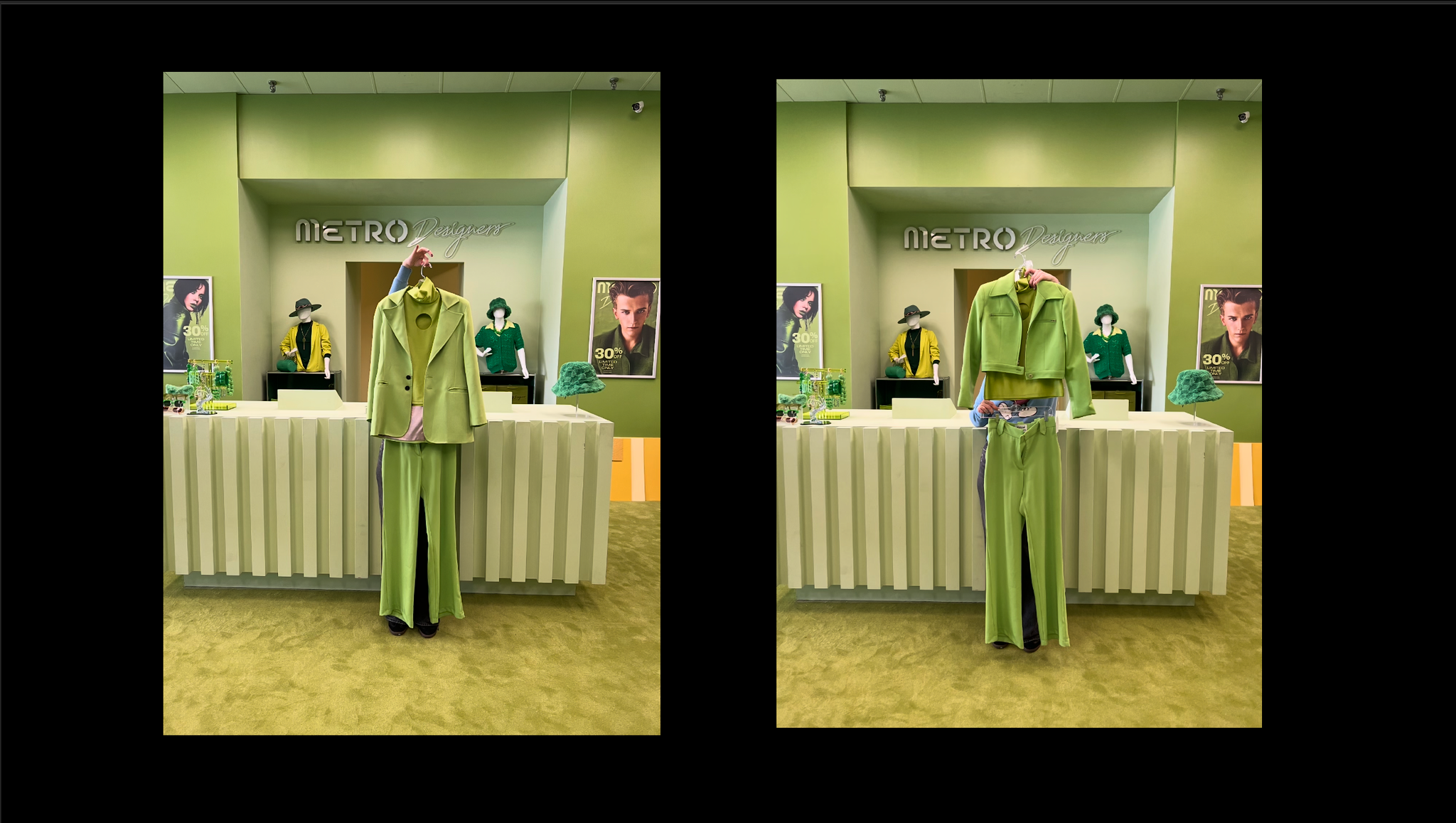
Courtesy of NEON
Carolyn Twersky Winkler at W Magazine described the outfits as “Dali-esque versions of the original designs.”
And the original designs are fascinating.
Tragically, dear reader, I cannot find legally useable photos of many these designs anywhere on the internet. So here is the way the costume designer described one accelerated design:
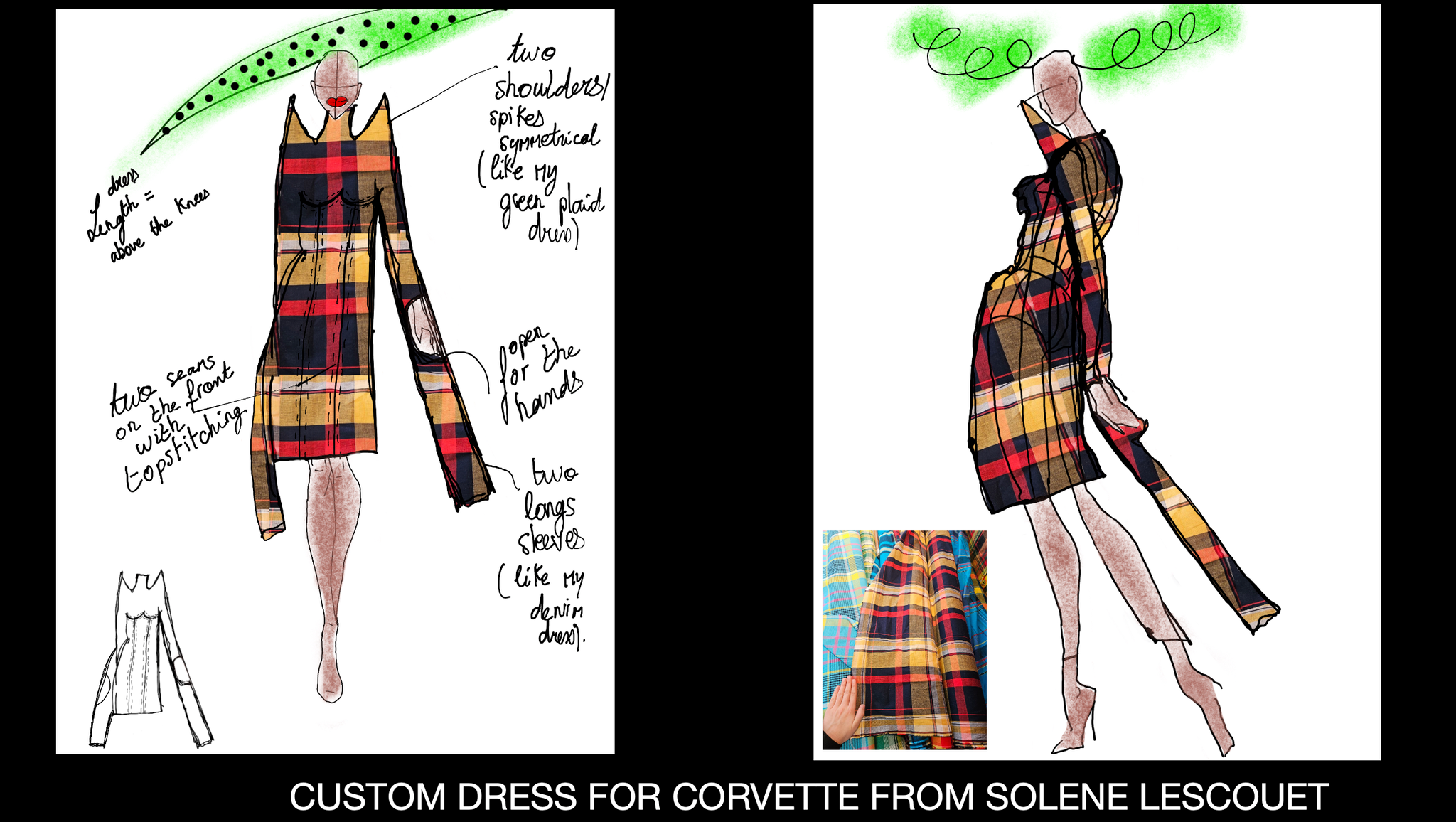
Courtesy of NEON
Let me add, it looked like Corvette was stuck inside one of those arts-and-crafts potholders I made on that tiny loom in Vacation Bible School. It was amazing, and Kurata cites Christopher Glass, the production designer, who developed the practical-effects approach.
The Gang tries the situation accelerator on all of their outfits. Sade (Naomi Ackie)’s pink tulle dress fills the room. Kurata told The Cut, “Tulle felt like the best material — it could fill a space easily without costing a fortune. We used practical effects to make it look like the entire room was filled with it.”
And then there’s Jianhu’s dress:
But my favorite accelerated design, by far, is Mariah (Taylour Paige)’s brown silk Collina Strada dress, which is accelerated into a “fuzzy, anatomically correct bodysuit complete with comically large areolas. “Boots wanted it to look like a Muppet,” Kurata said to W Magazine. “We didn’t want it to look too realistic because that would just be creepy.”

Courtesy of NEON
Exactly. Without ever directly saying so, the mathematical synthesis of the teleporter, et al, is also a satirization of the AI question and how it not only steals from creatives, but it appropriates designs often developed by, as Christie Smith calls the Velvet Gang, “Low-class urban bitches, with all due respect to urban bitches.”
Postmodernist Setting 2: Don’t forget, the Teleporter is also a Deconstructor
The best thing about the device Christie Smith developed is that it has an “undo” button—well, kind of. The “deconstructor” goes in the other direction of the “situational accelerator.” That means, instead of Mariah’s brown silk dress turning into that anatomically correct bodysuit, when the “deconstructor” setting fires on Mariah, she turns into her parents having the intercourse that made her.
Wild, I know, but also fascinating and genius, because when the Velvet Gang applies the “deconstructor” to Christie’s clothes… they literally deconstruct and pay credit to the factory workers in Qingdao.
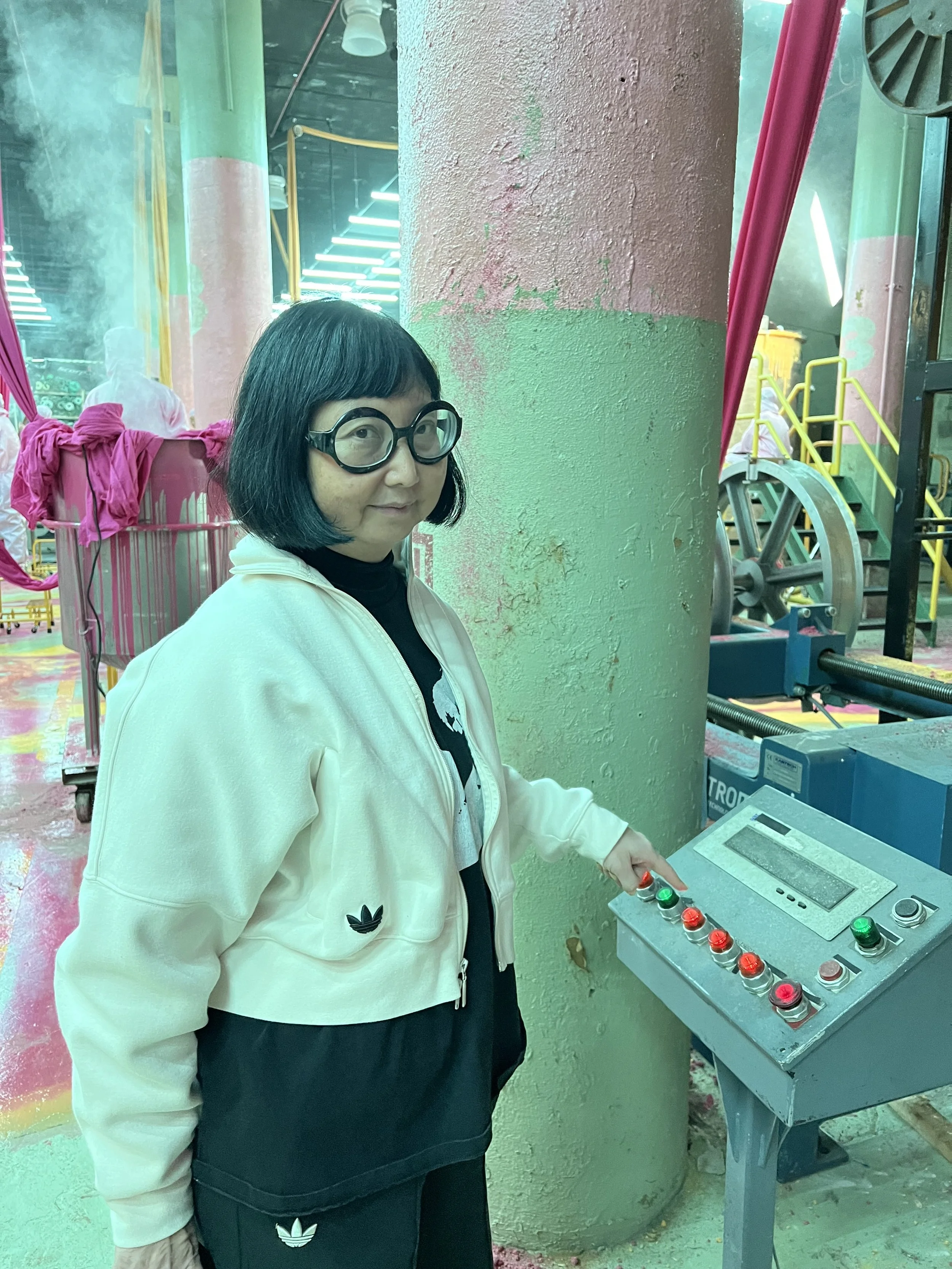
Costume designer Shirley Kurata on set for Boots Riley’s film I LOVE BOOSTERS.
Courtesy of NEON
It’s no surprise that creators (visual artists, musicians, writers, designers, anyone who makes things) are not only pissed off by the theft, but irritated at the lack of the developers’ creativity.
Like Matt Somerstein’s viral tweet summed up so well, “Can we get some AI to pick plastic out of the ocean, or do all the robots need to be screenwriters?”
What I mean is, while a creator may not be able to code or develop a teleporter (I definitely do not have that skill set), they can point out important questions, like: why would you use this valuable of a device only in the fashion industry?
The short, cynical answer is probably “money.”
But because our Velvet Gang + Jianhu are creatives, more or less, so Jianhu applies that technology to areas that make a humanitarian difference. Namely, she uses the “deconstructor” on her mother to reverse the illness she contracted as a result of working in the sweat shop. Now, that’s a good use for this technology. How creative.
If this story stuck with you, then you might also like these:
—THE DEVIL WEARS PRADA 2: What Happened to Nigel (Explained)
—Willy Wonka’s Chocolate Factory: Why is Mike Teavee Bad?
—What is the FORBIDDEN FRUITS Movie about? Girl Power, Witchcraft, Retail Therapy
