My main questions when I wondered whether to see Disclosure Day:
What is Disclosure Day trying to say about aliens?
How alien-forward is this gonna be?
Will I be too terrified to sleep after this?
Is Disclosure Day any good?
But before I dive into those questions (that’s a joke. It’ll land after you see the film), I should probably give a summary of the concept and answer, “What is it about?”

Image courtesy of Universal Pictures
Plot Premise of Disclosure Day
Here’s a quick overview. At pro-wrestling match, and Daniel Kellner (Josh O’Connor) is hands over a backpack full of company secrets that he was hired to protect. It seems like he is returning them as ransom, because his company, led by Noah Scanlon (Colin Firth) is holding his girlfriend Jane (Eve Hewson) hostage.
The company secrets are actually government secrets. Specifically, he has a backpack of evidence of extraterrestrial existence hidden from the world for 79 years. I should mention, the world is also, at this moment, on the brink of nuclear war—to the point that people are panic-shopping at gas stations.
While Daniel is on the lam with Jane, and guided by Hugo Wakefield (Colman Domingo), on local news station KCXE, meteorologist Margaret Fairchild (Emily Blunt) speaks on air in a bizarre, guttural, clicking tongue that no one can understand… except Daniel.
My main question-and-answer takeaway from this film was, “What is it trying to say about aliens?”
What is Disclosure Day trying to say about aliens?
So, there are two schools of thought among the people in the know (in the film).

Image courtesy of Universal Pictures
1 “The Truth will upend all established order.”
In the red corner, we have Noah Scanlon, who really, truly, and actually believes in his core, “That truth will upend all established order across the entire world.” And honestly, with the world as it stands right now… I can’t disagree with that. I think established order could be upended (and often is) by much less.
In case I haven’t been clear: I am terrified of aliens. I used to joke that they’re in my Trifecta of Shit I Can’t Handle. Hell, even Steven Hawking said if they make contact it probably won’t go well for us.
And, to pile on, former President Barack Obama said in that interview a few months ago that “they’re out there.” (He did clarify “They’re real but I haven’t seen them. And they’re not being kept in… what is it? Area 51. There’s no underground facility unless there’s this enormous conspiracy, and they hid it from the president of the United States.”)
To circle back to Stephen Hawking, he also said that if there was a conspiracy the government was covering up, they’re doing a better job at that than anything else.
Of course, for me to fight that red corner, I’d also have to agree that our “established order” is worth saving, which… I mean… look around.
Which leads me to the Dark Forest Theory. I visibly shuddered as I typed that. The Dark Forest Theory is that, basically, alien life exists. They know we’re here. And they know better than to reach out because we humans are the ones who annihilate life.
That’s about as much synopsis, interpretation, or analysis that I can give without spoilers, so if you don’t want Disclosure Day spoiled, then stop reading here, go watch it, and come back.
[SPOILERS START HERE]
So, that’s what the humans of Disclosure Day have done to the aliens: we annihilated them. Or at least, all of the extraterrestrials who have landed (crash-landed or otherwise) on earth. Because they ostensibly believed it was a kill or be killed situation. I’ll be honest: my fear can theoretically get me to this mindset pretty easily.
The thing is, humans recorded these atrocities. Which is what Hugo thinks people deserve to know.
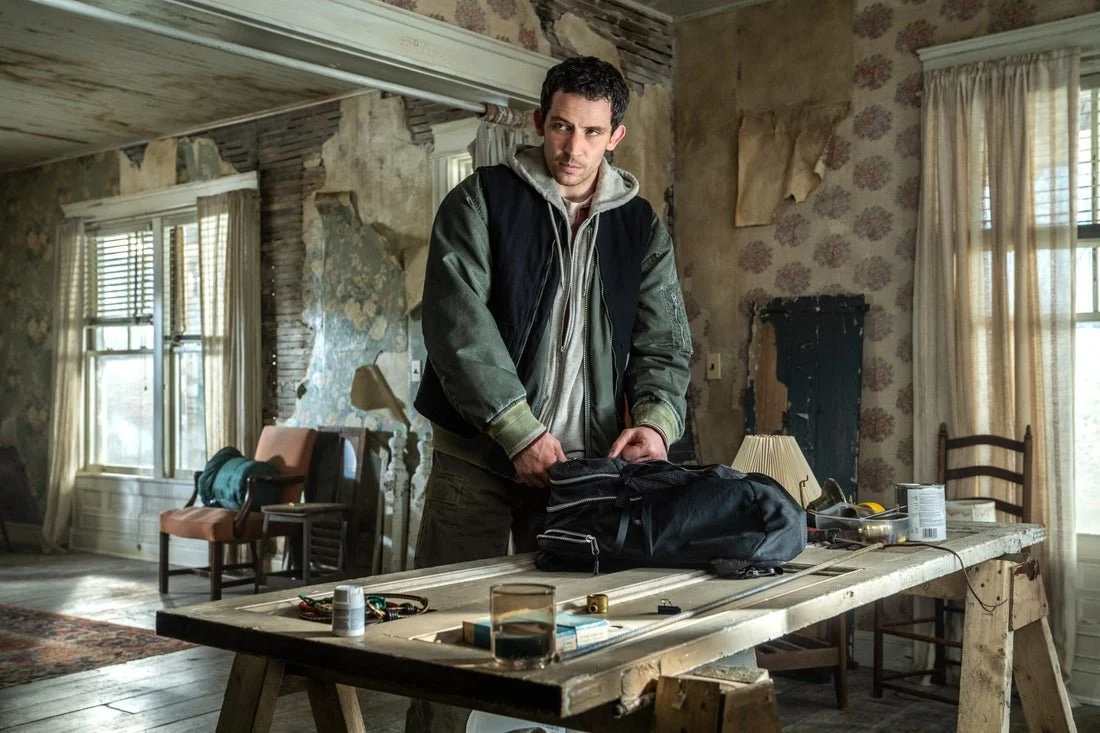
Image courtesy of Universal Pictures
2 “This 79-year terror campaign of lies has to end.”
In the blue corner, we have Hugo Wakefield (Colman Domingo) of the school of thought that, “This 79-year terror campaign of lies has to end.”
You might have thought the protagonist here was Daniel, or even Margaret. But really, they’re vehicles for the proxy war between Noah and Hugo. (That’s one reason why all of the Disclosure Day characters read a little underdeveloped: this is a science fiction action summer blockbuster, not an exercise in character development. Does it show? Absolutely. But this plot is not a character-driven one. It’s conceptual. So you just have to go with it.)
Hugo knows the aliens. He says that they believe (and I’m paraphrasing from memory, here) that empathy is the most highly evolved trait. They have it; we don’t. Not inherently. Not all of us. Hugo even helped one of them “escape.” He’s on video doing just that.
Hugo also understands that they’re here to save humans from killing ourselves into extinction. Remember, everyone’s panic-buying ahead of nuclear disaster.
That impending doom is what incites the whole action of the film (and there is a lot of action—from trainwrecks to car crashes to foot chases and UFO landings). Through Daniel and Margaret, humans have to learn empathy, and they have to do it now.
That’s where the film ends, with Margaret on worldwide TV, introducing the alien footage, introducing the actual alien, and beginning, “Listen.”
My “out of the theater reaction” was this:
“If Colman Domingo and Colin Firth had swapped roles, I would have been [in the red corner].”
My husband asked, “Is that because you’re always Team Colman Domingo, though?”
And the answer is yes, I am, but also not only that. Because, listen.

Image courtesy of Universal Pictures
How alien-forward is this story?
Well, it’s mostly about humans and the effect that extraterrestrial life has on humans/humanity.
The film spends a lot of energy trying to make the aliens not-scary. Let me explain the deer.
The aliens visit people—onscreen, Margaret and Daniel only—as animals, so they don’t scare the humans. (That would not work on me: I do not want to make eye contact with a fox or cardinal for any amount of time, especially if they have to look away first.)
The aliens even disguise the spaceship to which they lure Margaret and Daniel as children as the gingerbread house from “Hansel and Gretel.”
…I must ask the filmmakers, did y’all not read that story? You know that’s an evil witch’s house, right? The witch wants to fatten them up and eat them, and the kids get away because they push the witch into the oven. Also, Margaret sings “Someday My Prince Will Come” to soothe herself when the aliens-disguised-as-wild-animals break into her childhood bedroom to “give” her the ability to see people’s feelings, which is arguably the creepiest melody in the Disney canon. Not a great metaphor when going for innocuous, let alone helpful. (This is also one of the weakest moments in the film. It’s way too much CGI, to pile on another reason to the rest of this paragraph.)
At one moment, Daniel also says the aliens also “ruin” his life by “giving” him the ability to speak in numbers. That statement, too, is never revisited. As I aforementioned, Disclosure Day is not a character-development movie.
Moving right along, all in the spirit of “Aliens are good.”
Will I be too terrified to sleep after this?
In my earlier description, I mentioned that this is a science fiction action summer blockbuster. It is not a horror movie. It is not trying to scare you. Its object is not to scare. Just the opposite: I think this movie wants to open up the conversation about alien life, or at least destigmatize the conversation of alien conspiracy cover-up. At the very least, it wants us to stop viewing the idea of alien contact as “crazy.”
So much so that Jane—that’s Daniel’s girlfriend—was a former Catholic novitiate who talks to her Mother Superior about this idea. From the very beginning, Jane is not on board with the Blue Corner. She thinks that people need to believe in a superior being, not see it for themselves. She says, roughly, that it would end religion.
Later, she asks Sister Maura about the idea of alien life, and how that fits into humans being “God’s superior creation—”
Sister Maura clarifies, “On Earth. God’s superior creation on Earth.”
For my part, I appreciated the inclusion of God and religion in a respectful way. The easier route would have been to completely ignore it. I would have liked to see more of this spiritual debate (not a character-dev movie, I remind myself), and I am interested to see what other Christians and other religions think of this aspect of Disclosure Day.
What are some similar movies?
I said before, Disclosure Day is not a horror movie. It’s an adventure / sci-fi movie. I heard it compared to Close Encounters of the Third Kind (1977)for its powerful end note, and I can agree with that. Compared to Project Hail Mary (2026), it’s a totally different tone, and the main conflict is very distinct. It’s definitely no Independence Day (1996) or Signs (2002). It could not be farther away from Cloverfield (2008).
As I said, the purpose of Disclosure Day is not to scare. It is not a horror film. My best comparison to a similar movie? Imagine if Arrival (2016) was written and directed by the director of E.T. The Extra Terrestrial (1982)… Steven Spielberg, who did, in fact, direct Disclosure Day).

Image courtesy of Universal Pictures.
Is Disclosure Day based on true story?
Disclosure Day is not based on a true story—but damn if some of that UFO footage isn’t disturbingly realistic. The news anchor’s narration and acting in the final scenes was so enthralling that it sure did feel real. I can’t imagine that at least some of the film must have been inspired by first-hand accounts, but that’s one rabbit-hole my ’fraidy-cat mind won’t let me go down myself.
Disclosure Day releases in U.S. theaters this Friday, June 12.
If this story stuck with you, then you may also enjoy…
—Is PROJECT HAIL MARY Scary? Plot Summary and Analysis of 2026’s New Apocalypse Movie Explained
—Extraterrestrial Capitalism in LANDSCAPE WITH INVISIBLE HAND
—Tidings of Discomfort and Woe: The Christmas Prophecies of THE MOTHMAN
