THE DRAMA: This Film Is Not a Comedy. This Movie Is a Controversial Drama about Your Darkest Secret.
Trailers and marketing for Kristoffer Borgli’s new film The Drama has been very tight-lipped. At the advanced screening, we were even met with this clever little notice akin to a “please unplug for our ceremony” wedding note. Here’s the thing: everyone in this film makes mistakes. The film is about owning up to what you did to the people who matter, atoning for it, and doing better. Also, secondary thesis: a normal wedding is drama enough without any deep dark secrets causing rifts.
The suspense around the plot seems to be working in favor of the film, but it does leave a lot of what happens to the imagination. Here’s a quick film plot summary (not including spoilers that happen after the first act—those, I’ll give you fair warning in advance):
The Drama Film Plot Synopsis / Summary, No Spoilers Version
What is it about?
The Drama film begins one week before the wedding between Emma (Zendaya) and Charlie (Robert Pattinson). It starts with Charlie practicing his wedding speech to his best man Mike (Mamoudou Athie), in which he details their meet cute: he faked loving the book Emma was reading in a coffee shop. She ignored him completely, and it wasn’t until he came over to insist he was not hitting on her that she noticed him at all, explaining she was deaf in one ear. “Do you want to start over?” she offers.
Throughout the first scenes, Emma reiterates that same light-hearted acceptance, at one point playing silly music during their wedding-dance rehearsal to lighten Charlie’s mood, in another, pants-ing him while he complains about a disagreement at work. It’s one of the things he loves about her, he tells Mike, how she always “turns his drama into comedy.”
The inciting incident comes at their final food and beverage tasting with Mike and his wife, her Maid of Honor, Rachel (Alana Haim).
What is The Drama? Tell Your Darkest Secret
[SPOILERS START HERE]
It’s toward the end of the night, the f&b manager is becoming a little irritated at the couple’s indecision, and all four of them get a last glass of wine, and they’re all a little loose-lipped. That’s when Rachel encourages her husband to “Tell them about the dog.”
He’s immediately embarrassed. He explains that he doesn’t want to tell them. He didn’t want to tell her about it in the first place.
Rachel explains to Emma and Charlie that it’s The Worst Thing He’s Ever Done. They told each other their Worst Things before they got married. “And then,” he said, “we’d never speak of it again!”
She then bullies Mike into telling them, saying more or less, “If you don’t tell them, I will.”
Characters
Here’s the thing: Rachel is a bully. She’s bullying her husband into revealing his darkest secret, his most sincere shame that he wants to keep buried forever. It is, by the way, not that bad: he instinctively used his girlfriend as a shield when they were getting attacked by a feral dog—after she started kicking the animal.
He then insists that Rachel tell hers. She completely minimizes the terrible thing she did, indicating that she does not actually feel ashamed for it: “I locked a kid in a closet once.”
When they ask for details, she says that she was “bored” one day, so she followed a “slow” neighbor to an RV he found in the woods and locked him in its closet. When his parents came by to look for him that night, she said nothing, and by morning there was a full search party in swing. She doesn’t know what happened to him, only that “he was fine.”
Charlie then asks, “What would you have done?” if he hadn’t been found, and she says she would have probably said something. Then she diverts the attention to the other couple, the soon-to-be-married ones. The ones who have not had this conversation, did not plan to have it, and certainly should not be having it in front of other people, even if they are close friends.
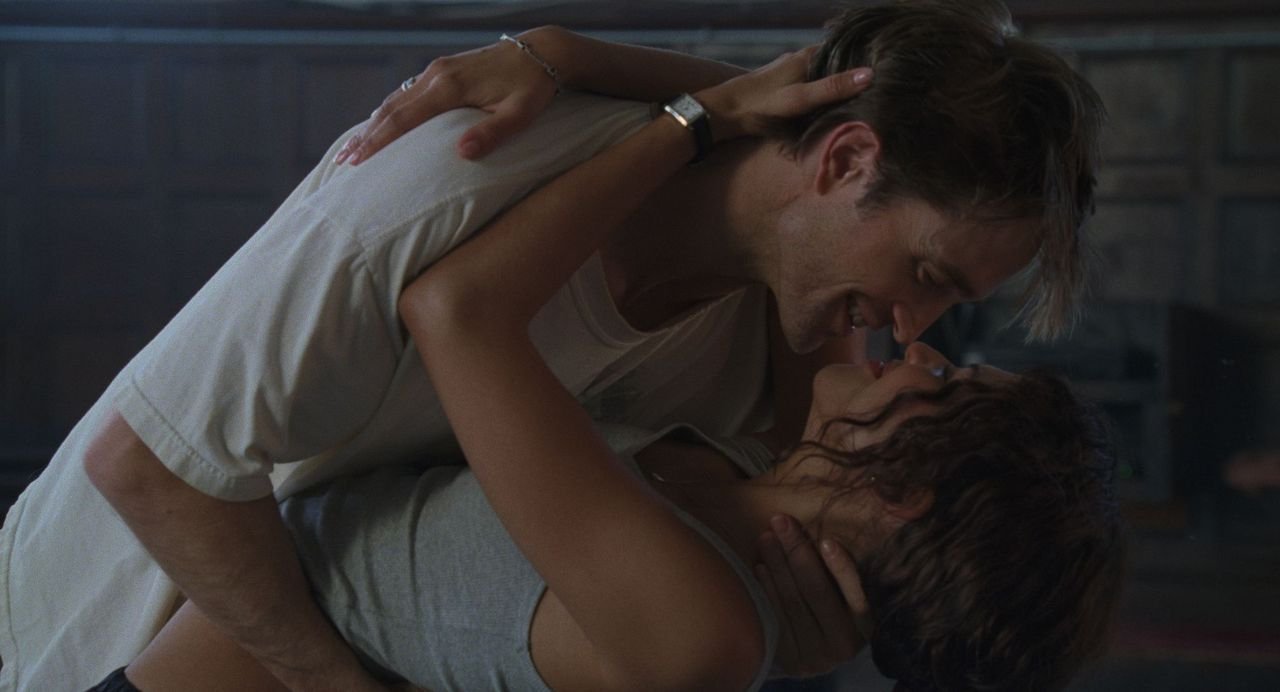
What did she do?
Charlie begs off the question, thinking really hard for like six seconds and then giving a slapdash answer of “maybe he cyberbullied someone once.” It might not be honest, but this is the correct way of diffusing this situation.
About Charlie: he seems to gets frazzled over small things because he hasn’t had to deal with real, heavy, serious issues before… and what a wonderful way to live! He’s a museum curator, he’s from Britain, and based on the lavishness of their wedding (and the fact that Emma’s family was military), there’s a good chance he’s at least upper-middle class, and he’s probably been able to avoid a lot of trauma thereby. No heat, just an observation of Charlie and a possible synthesis of why he reacts the way he does to what Emma is about to say (which is not a small thing).
When it’s Emma’s turn, she—like everyone else, she thinks—tells The Worst Thing She’s Ever Done: “I planned a school shooting.” She didn’t do it, but she planned it out, made the videos, got the weapon, and then didn’t do it.
Rachel, the bully, immediately turns on her, outraged.
This is where the film’s controversy comes in.
The Drama Movie Controversy
Look: there’s no justifying a school shooting. There’s no justifying murder. There’s no way a victim of a school shooting NOR THEIR PARENTS will ever not be triggered by anything involving the murder of children. Nor should they. Nor should anyone expect it of them. At this topic, you feel how you feel when you feel it, and outrage is a totally normal reaction regardless of how it’s handled.
What about the director’s controversy?
There’s a whole essay that Kristoffer Borgli wrote himself about his intimate relationship with an underage girl. You can check that out at this link.
But… is it a comedy?
People are also identifying the genre of The Drama as a dark comedy, rather than… a drama. I didn’t think this movie was funny nor trying to be funny, and I don’t think school shootings are funny, either. (I’m also the person who will not watch a comedy about Nazi Germany, period, if that helps with perspective.)
There are ironic moments, wry moments, humor inserted in unlikely places, sure. But I would not call this a comedy, and I don’t think The Drama making fun of school shootings.
I might think differently, though, as I said above, had any of it happened directly to me.
And as for why the marketing team is deciding to market it as a comedy… I don’t understand that choice at all. You’re setting a lot of people up for bad dates, at least. I mean, what are we supposed to think of the movie when this is the main film poster?
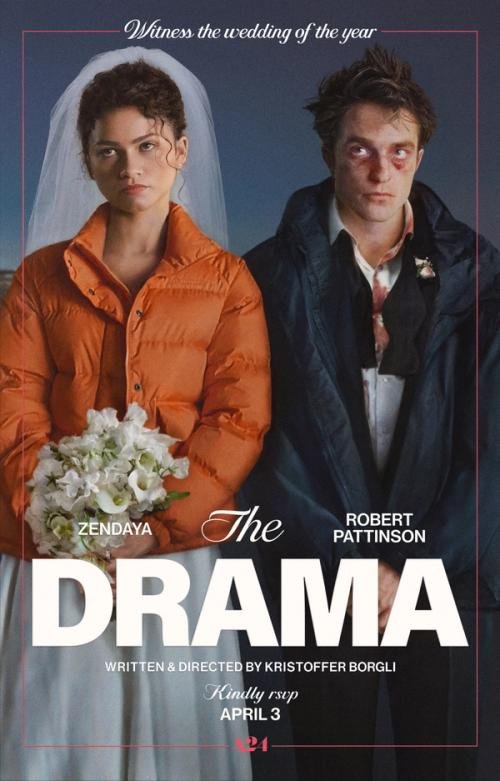
Courtesy of A24
Okay, but what did she do?
That said… Emma didn’t shoot up a school.
And yet, no one really asks Emma any follow up questions before Rachel attacks. Rachel, who insisted and bullied everyone into this false intimacy to begin with.
It’s not until much later that anyone asks what I think is the most important question: Mischa (Hailey Gates), when Charlie asks her hypothetically at work “What would you do if…?” finally answers with the question, “Why didn’t they do it?”
Why didn’t she do it?
To me, it is unfair to ask people to share their secrets if you are unwilling to meet whatever they say with if not amnesty at least an attempt at understanding… and I’ll talk more about the terrible person who is Rachel in a moment.
Charlie does try to understand the situation the next day, but Emma doesn’t want to talk about it. She’s so deeply (rightly) ashamed that she’s buried the memory and wants to keep it buried.
She tells him that she was about fifteen years old. That there was another shooting, at a mall. That everyone at school came together for the student who died. That she joined and anti-gun group. And that she got over it, threw her dad’s firearm in the swamp, and tried to never think about it again.
But Charlie can’t really accept that, even if he wants to. He fixates on the fact and he spirals out. Emma, for her part, doesn’t really know how to make it any better since she has also not reflected on why she almost did the most terrible thing that probably anyone can do.
Which she didn’t, in fact, do.
But what is the movie about?
I keep harping on the fact that she didn’t do it not because it doesn’t count (although, it’s far from her actually having done it). I keep coming back to it because every single person who has ever existed has done something awful that they regret.
Everyone. I’m including you. I’m including me.
If you don’t know what your thing is, think about it. I’m not saying you have to tell everyone—that’s your call, but definitely don’t let someone bully you into revealing it when you didn’t plan to—but you should think about it. You should reflect on it. Why it was bad, why you did it, why you didn’t do it, what drove you to it, because eventually, your sin will find you out. You want it to find you out, because if you keep it too much of a secret, you can’t atone for it.
And it should go without saying, but if you’re about to take a vow to love someone forever, then you need to tell that person, at least. And you should do it well before the week of your wedding.
So, what do we do with The Worst Thing You’ve Ever Done, then?
Even if you didn’t actually do it, if you came as close to it as Emma seems to have done, burying it seems like the most dangerous option. This movie’s thesis seems to be that you should bury it, lest it blow up everything in your life.
But I disagree: understanding how you got there is so important, especially to prevent that recidivism. It’s one reason (among many) our prisons don’t work to prevent violent crimes: there’s very little psychological support.
If I—admittedly, a person with very little psychological training and who only worked with emotionally disturbed youth exactly like Emma for a very short period—look at Emma’s case, I see a miracle. Almost Hand of God level intervention, like this one, which happened for a child that I actually knew personally. (He was the one who charged the school. Or, almost did.)
What I mean is: I see a very lonely girl. Who grew up into a very lonely adult. Who never really learned how to make friends, for whatever reason. As a child, she thought she never would, which seems largely due to her family moving to accommodate her father’s military career.
But it’s also because the girls at school bullied her. (Charlie says, “What, that’s it?” when she relays the stories to him, but let’s remember that he minimized his own cyberbullying.) And she didn’t seem to get very much attention at home. Or have other communities.
UNTIL the other shooting happened, and a boy at her school died as a result. She saw not only the fallout of what she would have done (which a child can hardly fathom), but she saw the whole school, faculty and all, band together in a community. OF which she was now a part! And then, when she gets personally invited and elected to speak to the anti-gun organization, she was fully enmeshed in the community of friends that she wanted all along.
As for how she lives with having almost done the most horrible thing imaginable… she was a child. I can see how she might equivocate that she is atoning by being completely deaf in one ear as a result of firing her weapon too close.
It seems to me like a flaw in the writing that Emma has no lasting friends as an adult, but if it is not, if there’s some through-line that was left on the cutting room floor, then no one ever taught her how to make friends. The lack of social skills alone is a tragedy in itself, but it’s also how a bully like Rachel became (and stayed) Emma’s Maid of Honor.
A Normal Wedding Is Drama Enough in Itself
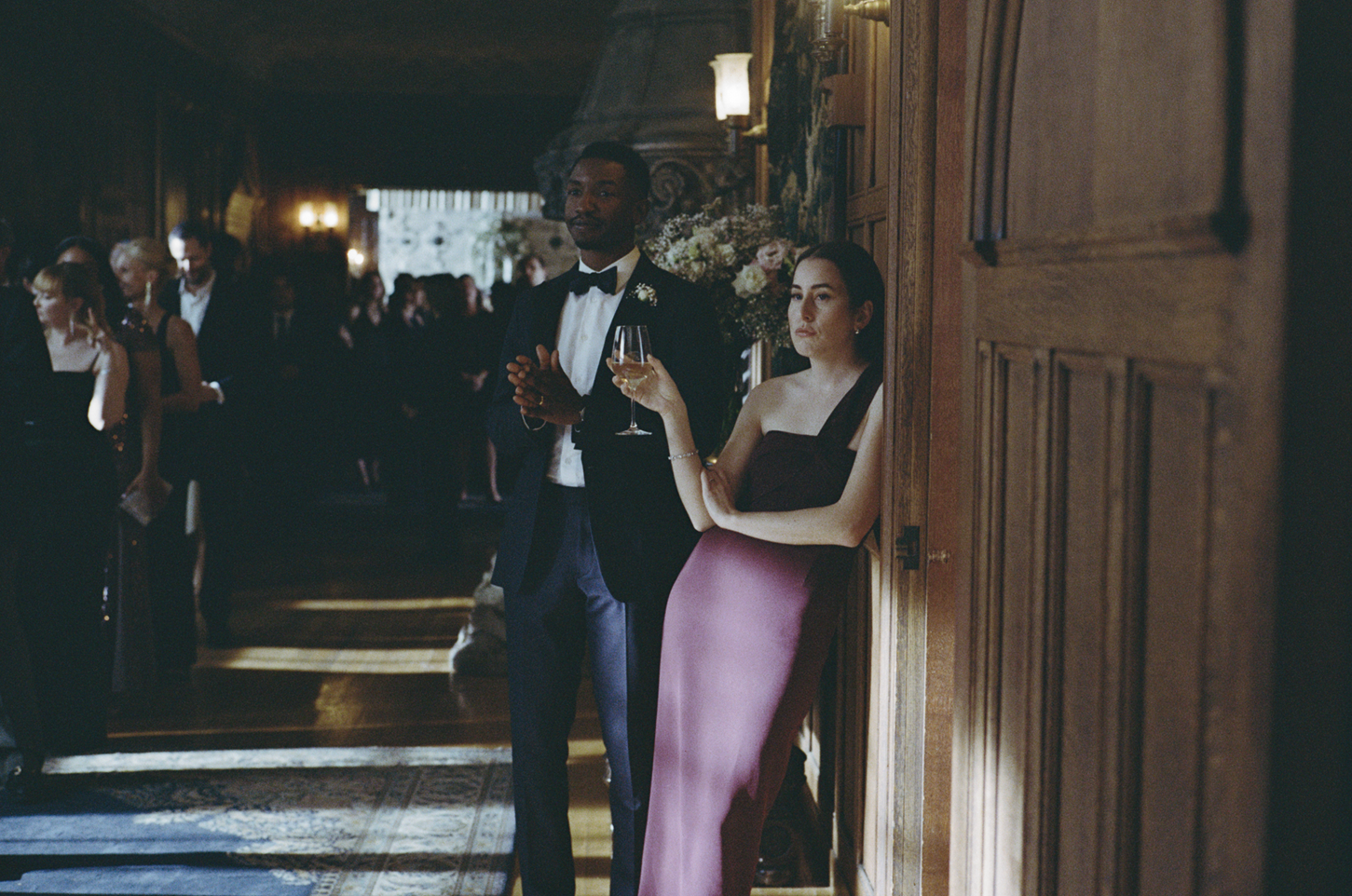
Courtesy of A24
Learn from Emma and Charlie’s mistakes: here is a list of reasons you are allowed to uninvite guests from your wedding.
If someone is not absolutely thrilled to attend.
If someone is on the fence about whether they like either person getting married.
If someone actively dislikes anyone in the wedding party.
If someone does anything except wildly support the wedding party.
If they don’t want to attend.
“I don’t want to” is reason enough. It’s your day. You should do exactly what you want, because you’ll never be able to be this selfish again in your entire life. There are enough people you actually like who won’t make the cut just because of the numbers. So let me say it again: No Pity Invites.
Rachel should not have even been at that wedding. She definitely shouldn’t have stood next to Emma as her Matron of Honor, or in any role of support—y’all know that Rachel would have been by Emma’s side all day long, right? You realize that, right?—She absolutely should not have been allowed to speak aloud in front of everyone, and that expert wedding DJ should have cut her mike if the Best Man wouldn’t do it.
The Drama is in US theatres Friday, 3 April.
If this story stuck with you, then you might also like…
—The "Real" Witches of MACBETH
—Reinvigorated ’90s Nostalgic Horror In I SAW THE TV GLOW
