MARC BY SOFIA, a Sofia Coppola Documentary Film about Marc Jacobs in which Fashion is Theatre, Plot Summary and Analysis
Marc Jacobs is a household name, even for those of us who only know designers (and how to pronounce their names) from hip hop and rap music. In Marc by Sofia, where even the title is a fun homage to how designers name their collections, Sofia Coppola beautifully curates the story of fashion designer Marc Jacobs. In their decades of friendship there’s clearly a trust between the two that they will do right by each other, and they really do.
That said, I came to this film to learn. I care about what I wear. I know a little bit about historical fashion trends of the past, but I don’t pretend to understand the industry. The best I ever came to comprehension was watching The New Look on AppleTV+ and writing about Coco Chanel and the Aryan Laws. I love crime writing.
Part of what intrigued me about this film is the offhand line Marc Jacobs says in the trailer, “Go to Marc. He’ll dress you for your trial.” If you ever wondered how Winona Ryder, Lil Kim, and Courtney Love all looked so chic, professional, mature-in-a-hot-way in the courtroom… it’s Marc Jacobs.
But. I am interested in fashion design outside of the courtroom aspect, too. And I think that makes me a target demographic for this film.
Those who already know a lot about Marc Jacobs, the person, the story, his numerous lines and collaborations, might not learn much new information about him/them—or they may, since I don’t know what constitutes common knowledge—my point is, this film doesn’t read like a traditional David-Copperfield-style biography in which We Begin at the Beginning and go chronologically through from birth to death. It’s Sofia Coppola’s first documentary feature, but it definitely still has the aesthetic of being made by Sofia Coppola.
And besides, Marc Jacobs is alive and thriving. A traditional biography wouldn’t be a complete story. This documentary goes deep rather than wide.
Plot Summary
The plot of the Marc by Sofia documentary centers his Spring Summer 2024 runway show.
But that’s just the frame. Over the course of the preparation, we hear about his major influences, friendships, collaborations, and, my favorite element, his creative process.
For me, as a writer, the processes of other artforms are always so fascinating to me, and the deep level of specificity to which Marc Jacobs (and Sofia Coppola) plunge in this film was my favorite aspect.
The Granular Details
I came to this movie to learn, and I did learn.
I don’t think I understand the industry as a capitalist enterprise, still—which is fine—but a few granular details still stick with me days after seeing this film.
The Gauge of the Knitting Needles
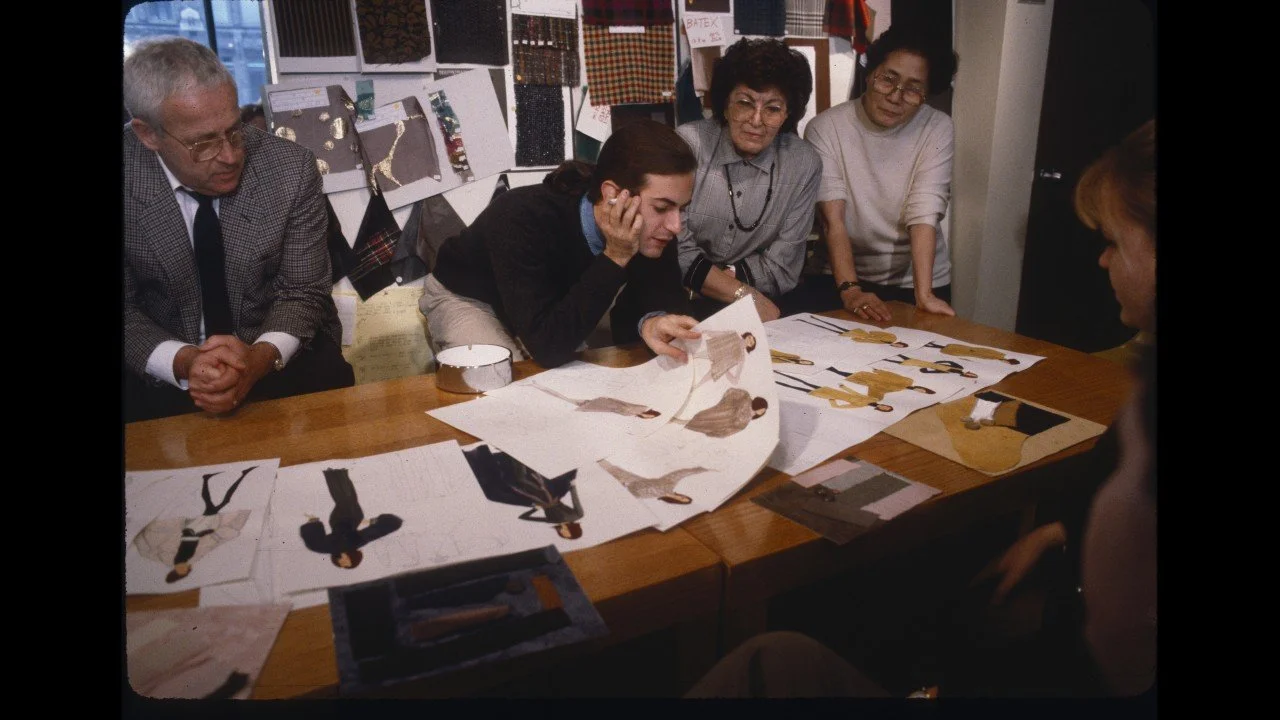
In one of the opening scenes where Marc Jacobs prepares for the runway show, he sits down at a workshop table among some swatches and starts to compare two of the best options.
The discussion between him and his technician—artisan? Textile curator? I don’t know real her title, but she has procured these tactile options for him, overseen their creation, and explains to him the fiber and the gauge of the needle for each sample.
He explains that he wants a wool-like texture, but he wants it to be translucent, and then he suggests maybe keeping the same weight of the fibers, but increasing the needle size.
I loved that interaction—it’s two creatives at the height of their game discussing how to achieve the desired effect, and it made me understand, too, why even though sometimes the fiber content of a garment I have is what I wanted, the way it hangs is not right.
Courtesy of A24
A Couple Tangents…
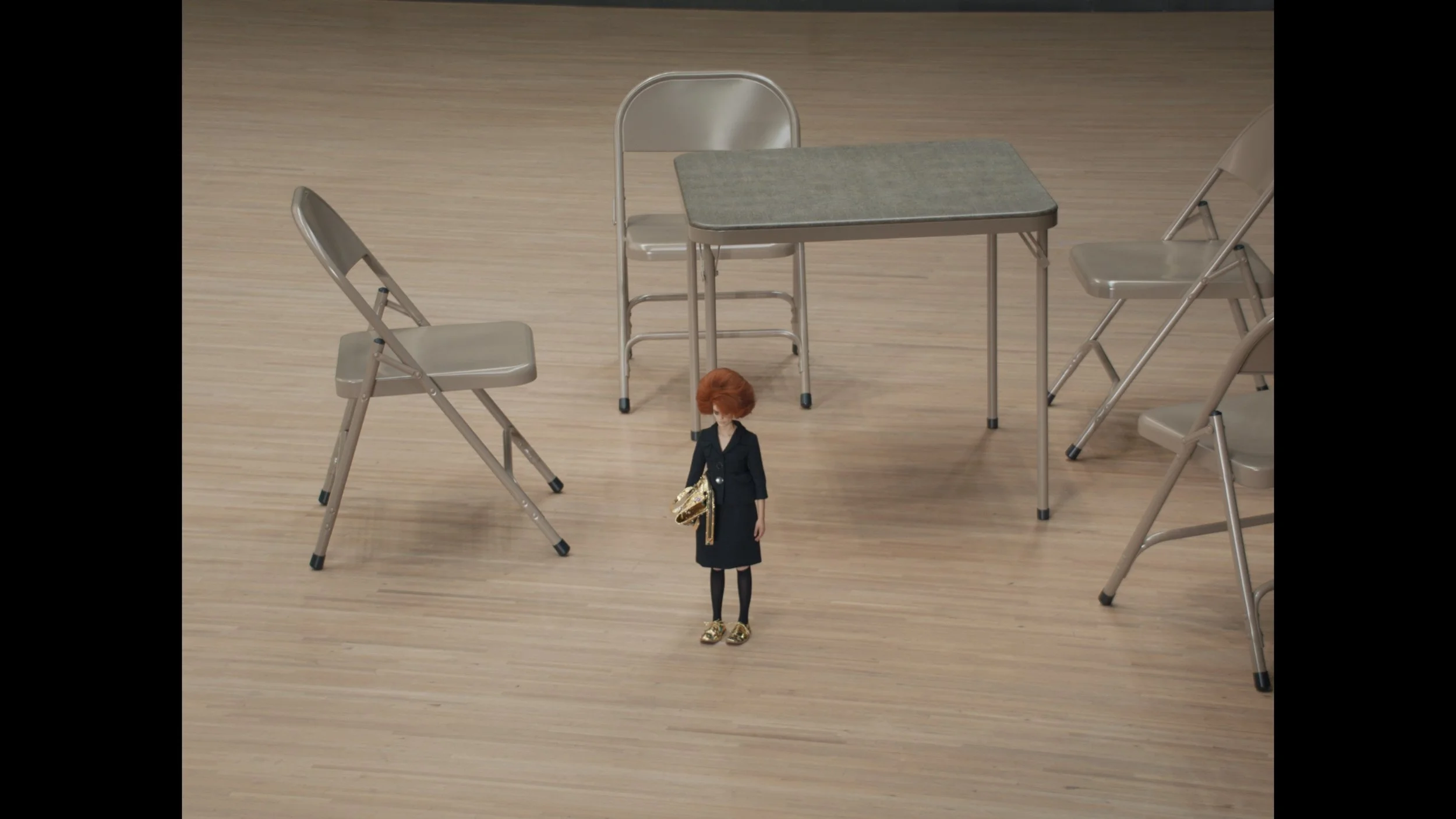
As an interesting aside, I once attended a lecture on costuming for puppets at SCAD Fash, and the size of the fibers in fabric is the biggest reason why fabric does not drape the way it should in miniature.
As another interesting aside, as depicted in The New Look, when Christian Dior, Balenciaga, Hermes, and Pierre Balmain (among many others) all create the traveling miniature Théâtre de la Mode so they could make new designs while saving precious fabrics, the weight and drape was also a big concern.
Last tangent. As a woman who has needed extended sizing during variations in my weight, I appreciate what y’all are trying to do… but the fabrics aren’t the same in all scales. Namely the width and stretch of bra straps. You can’t just make it bigger and achieve the same effect, y’all. DD+ need a load bearing strap.
Formative Experiences
In this film, there’s no fluff. I know I’m going into my favorite granular details, but each of these anecdotes, while interesting in themselves, also help to shape our main character’s energy and propel the plot. I said before that this is not a “I was born, I grew up” type narrative, and it isn’t, but occasionally, Marc Jacobs would trace his interest in something to a formative experience.
His education
I never left a scene thinking, “Irrelevant.”
A couple of times Marc Jacobs is asked questions from current fashion students at his alma mater, Parson’s School of Design. This Q&A happened at his store, Bookmarc. Let me be the first to say that those students had excellent questions, which is not always the case (or, Sofia and Roman Coppola made some excellent edits, which is just as likely). One of them asked about his first show, when he was in college, and whether they thought his education actually helped him.
He was ambivalent in his answer, which is (as a person with a terminal degree and some success in a different creative field, I can verify), the only honest answer. He talks about how his mentor Perry Ellis recommended that he attend Parson’s, so he did. But he was in and out of school—“the real world is happening out there,” he told the student.
Then we learned about his first show, in which his now senior designer critic Perry Ellis told him to choose between three drawings, and he said he had to do all three or it didn’t make sense. A typical artist’s answer. Perry Ellis told him he was biting off more than he could chew, that it would be hard to execute just one of the designs, but he was welcome to try.
About those naysayers…
This is a theme running through his documentary: people in charge did not support his ideas when he had them. (Granted: Perry Ellis sounds incredibly supportive.) Marc gives one example of the infamous Louis Vuitton brand/logo in 1997. He wanted to deface their traditional logo, and they said no.
Then they said, you can do it for the show, but we won’t sell it.
So there were people queueing orders for a bag they never intended to sell. “And then the counterfeiters released it,” he says.
It’s a common trend among new ideas: one day, everyone will have always been against this; or, alternately, one day, everyone will have always supported this.
That sentiment is a great encouragement for anyone trying to get their ideas off the ground in the face of negativity, but even more so, while being actively prevented from doing so by the people with the money.
Courtesy of A24
His Grandmother
Marc Jacobs really does more to highlight the people who were in his corner from the beginning, namely his grandmother and his mother. Naturally, his grandmama got my attention because she was of an era (and a class, apparently, although he never says so outright) in which a particular outfit is for a particular function. He gives the example that she believed leather gloves should only come in black or white, and so she never bought any other color of leather gloves.
He not only grew up with this baddie who had a weekly shopping schedule at department stores like Bergdorf and a dining-out agenda to complement it, but she also helped him creatively. I mean, he went along with her to hair appointments during his formative years and whatnot, but she also taught him to knit. And, when he was in school, she was the one who helped him execute his three (not one) designs that eventually led to his first commissions. Or, at least that’s the way I understood it from the way the narrative was framed.
That was inspiring, too, because, well, yes, she was his grandmother. She obviously cared for him as a grandmother, but her influence, her glamor, helped him grow his own creativity. And isn’t that what all of us want, ultimately, for what we do to matter to the people we love?
Eccentric Glamour
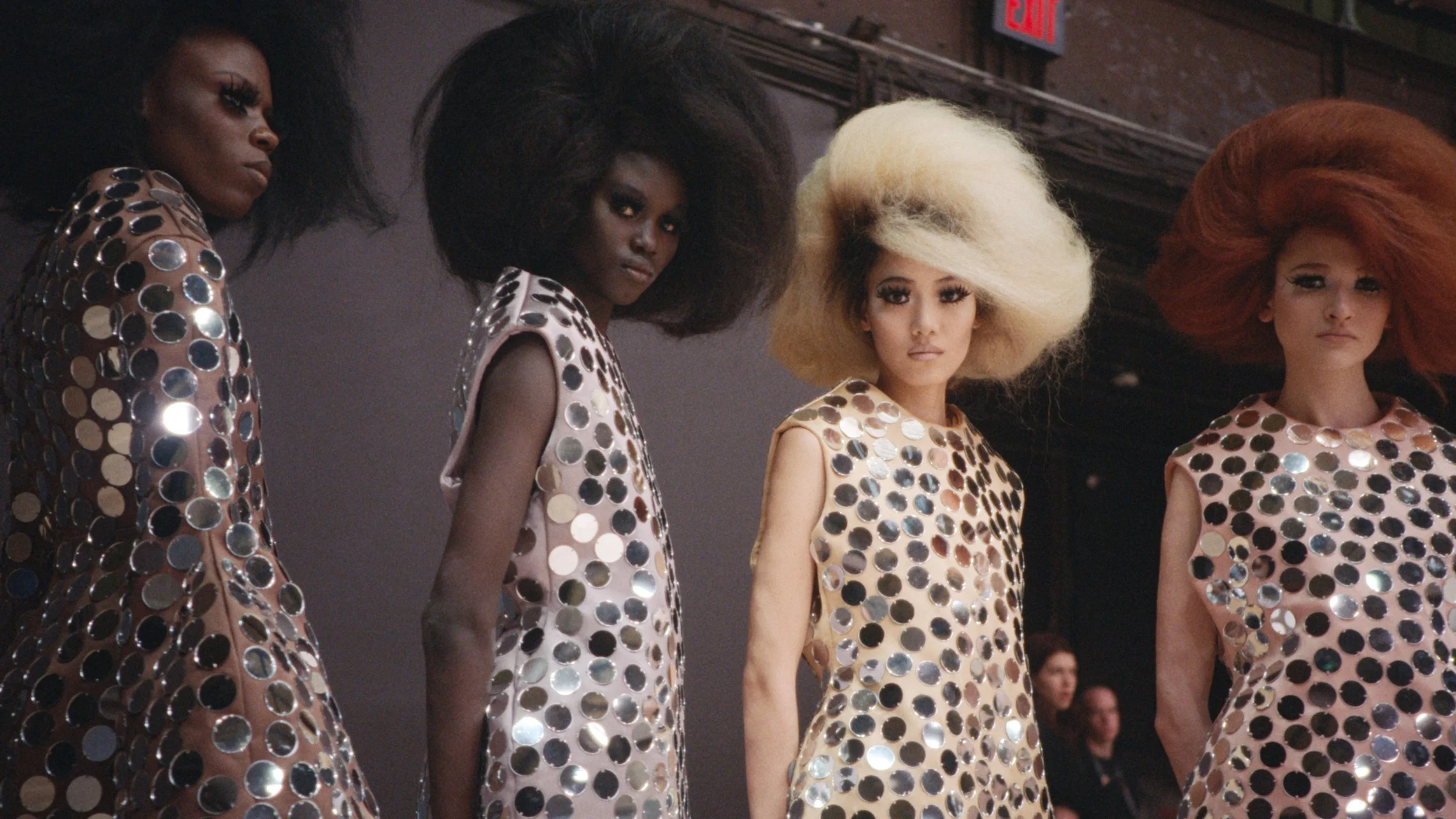
And speaking of the women in Marc Jacobs’ life—my God, can he bring them to life in a story! In maybe my favorite childhood anecdote of his, he tells how, after his father passed, his mother would get ready to go on dates. While she put on her mascara, she took a knife to a black velvet ribbon, scraped off the velvet, and added it to her lashes to create an even blacker, chunkier eyelash.
I love a narrative of eccentric glamor. And I love that this memory inspired the makeup for his 2024 runway show.
Courtesy of A24
Fashion Is Theatre
Earlier, I said that the processes of other artforms fascinate me as a writer. I don’t want to read another (*cough*Stephen King*cough*) book about a writer writing. And I don’t want to listen to another (*cough*Drake*cough*) rap album about rappers rapping. But documentaries about fashion designers’ creative process? Sign me up.
This kind of media is partly fascinating because they’re so different, sure, but they’re more interesting because they’re so similar. At one point, Marc Jacobs says if he wasn’t a fashion designer, he’d want to be a theatre director because “doing the fashion thing is really the same kind of process: the casting, the music, the set, the costumes… only in fashion you get to do all of it.” After seeing this film, I can safely agree, fashion is theatre. “The clothes may be the main part, but it’s really about telling a little story made out of shapes and colors and fabrics. It’s crazy, but the kind of crazy I love. You’re making something exciting.”
It’s a significantly compressed stage time and run time for a runway show, but the whole village’s work, over the course of months, coming together in one seven-minute performance can’t be anything but theatre.
And it fits, of course, that I viewed this documentary as a third genre, film. Which is also theatre. Full circle. No. More like same-same.
Marc by Sofia is in theatres this Friday, March 27.
If this story stuck with you, then you may also enjoy…
—INTERVIEW: Courtney McBroom, Lessons in Chemistry’s Food Consultant, Talks Vintage Recipes, Cookbooks, and Cooking for the Screen
—Estate Sales 101: Where to Find Them, How to Shop Them, and Other Expert Tips
—The Beauty Who Created the Beast
—The Overlooked Art (and Drama) of Courtroom Sketching
