How to Prepare for Renovation – Part 1 of 4: Learn from Your Friends’ Mistakes
I have heard so many horror stories about general contractors… and so few good experiences.
I’m here to tell you that I am the unicorn: we renovated our tiny bathroom, and we are happy with the timeline, the finished result, and the cost.
This is a series of how to prepare for your renovation. But don’t worry! The actual bathroom renovation before and after pics are coming. Just, first things first.
Much of the time, we don’t get things because we don’t ask for them. And sometimes we don’t ask for things because we don’t know what we need. So here are the questions you need to ask to get what you want—and to determine what you want—when it comes to bathroom renovation ideas on a budget!
We planned this remodel the way we planned our wedding and our tattoos… in four steps:
We collected the experiences of our friends and learned from their mistakes
We hired a contractor and got the ball rolling
This process worked just as well as it did with the wedding and tattoos, both of which, not to brag, were/are epic. Here’s our bathroom renovation preparation.
If you want to join the journey, be sure to subscribe to Wayward Curator so you don’t miss any updates to our bathroom renovation.
And in case you missed it, here’s our abomination of a primary bathroom.
While you’re there, go ahead and follow me on IG!
This is Part 1 of 4: collect the experiences of your friends and learned from their mistakes
First, take notes.
Ask your friends if they are happy with their construction projects.
There’s no better referral than word-of-mouth from someone you trust whose house now looks awesome and exactly like they wanted it.
That’s hard to find. Horror stories are much more abundant.
To paraphrase Leo Tolstoy, all happy renovations are alike; each unhappy renovation is unhappy in its own way.
Once in a while, someone will answer, “Yeah, we love the result! But—”
Collect the names and numbers of those contractors who do good work. That’s the most important element, that they got what they wanted.
What went wrong?
Most frequently, our friends were not happy in any regard, and they immediately started pointing out flaws. Take notes here. You will have to ask questions about how to avoid those flaws. By the way, the disappointments are often not because the contractor is trying to withhold information or mislead you—it’s just so obvious to them that they forget to mention it.
But sometimes, the contractor is straight up stupid or inept. These are the worst horror stories about home renovation I’ve heard.
work dragged out half a year or more because of permitting (doesn’t everyone want their pool swimmable in November?)
delayed occupancy because of not meeting code (they could not move into their new-built house!)
existing issues destroying the work because of a failure to disclose by former resident (a sump pump was clogged, flooded the entire ground floor, rendering it a biohazard)
backordered parts prohibiting work, with the house in complete demolition (showering at the gym and shitting at the nearby gas station wtf)
failure to complete the job at all (my mom’s new guy just didn’t finish the roof repair)
straight-up disappearance of the contractor (my dad tracked the guy down in a fast-food drive-thru—no escape now, mothafuckahhhh)
One job was so botched that after months in real estate court, my friend was awarded 150k in punitive damages… that’s on top of the cost of paying another contractor to repair/finish the work.
And when you ask your friends, what the fuck? They inevitably sigh and say, “Yeah. That’s just the construction industry.”
I reject that statement: it’s how we allow the construction industry to behave. And what do you do with a misbehaving child? You discipline them. I don’t mean you give them an ass-whooping at Chik-fil-a (dad). That doesn’t solve anything except releasing that anger.
Get ahead of the problems by establishing clear expectations.
You establish clear expectations and reward behavior that is favorable. You also reference those expectations when you feel like something is about to go off the rails.
So, I asked my friend who went to court, what does your lawyer recommend so that doesn’t happen to me?
She said, bottom line, you need a contract with a penalty clause.
Put those expectations in writing.
My non-negotiable was a contract with a penalty clause. I did not lead with that in the negotiation, of course, but I knew it all along, and I knew that no matter how much I talked to a contractor or liked them or trusted them, I would walk if they didn’t want to do it—and I wouldn’t be bitter about it!
Sure, shit happens. Sometimes parts get delayed and it’s beyond our control. Sometimes the weather prevents construction. Of course, if I change my mind about what I want, and you have to issue a Change Order, that’s going to add on time. I’m a reasonable person. I understand that. I’m not trying to screw them: I’m playing defense over here. I just don’t want to get screwed.
A few negotiation tips
As with any negotiation, you have to be willing to walk away from the table. It took a while for me to reach the mindset, but the best advice I can give is this: do not proceed to the next step until you have accepted the mentality of, this will either happen according to my most important principles, or it will not happen.
A similar piece of unlikable advice: even after the job is done, contractors almost always have to come back for touch-ups. Don’t let that hurt your feelings. Things just happen when you start living in a space. That means you definitely need a contract that states they will do post-job repairs.
I’m not accusing the industry at large of washing their hands when they think they’re done. But you do want to establish the expectation that contractors are responsible for their work for one year after they do it. That is the industry standard on almost all construction, so don’t let them walk you back on that one—that’s why they have insurance. (Oh, wait, they don’t have insurance? I guess we’re done talking then!) But seriously, if everyone is clear on that fact, no one’s feelings should get hurt when they have to come back for a touch-up.
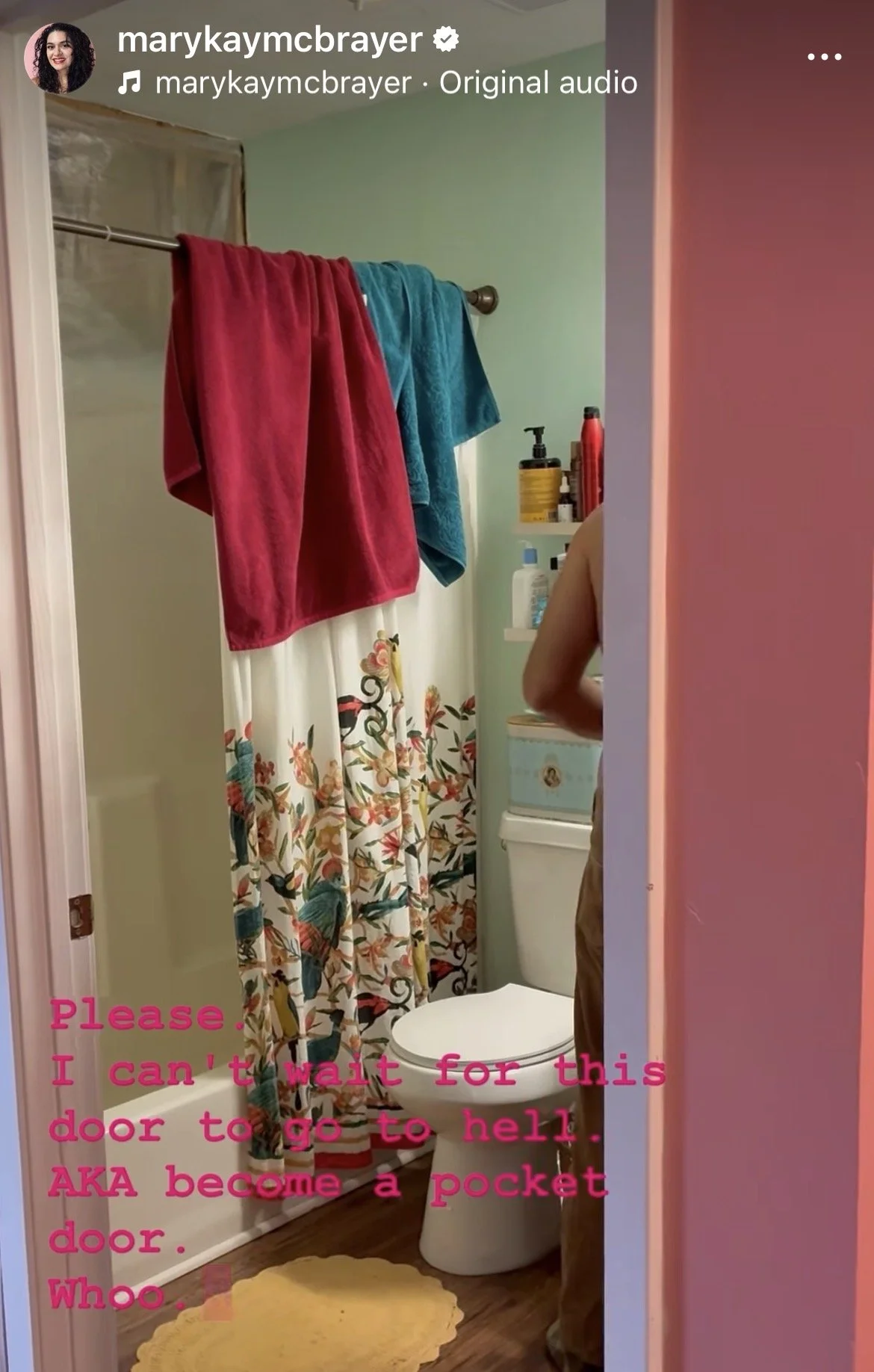
Candid thoughts about our primary bathroom.
Clear up your own expectations, too.
Like I said before, it’s important to establish expectations for everyone, including yourself, and hold everyone to those expectations. Including yourself. Hell, especially yourself.
It’s crucial that during your hiring process, you stick to the principles that are most important to you.
That means, before you even talk to contractors, you should determine, what are your most important principles?
To make sure you don’t miss the next installment of the Bathroom Reno, make sure you Stay in the Loop by adding your email in the sign-up below!
If this story stuck with you, then you might like…
—How to Prepare for your Bathroom Renovation, Part 2: Visualizing Your Dream Bathroom
—The Best Period Pieces to Watch this Winter
—DIY Tutorial: How to Create a Decorative TV Cover in a Small Space
—Estate Sales 101: Where to Find Them, How to Shop Them, and Other Expert Tips
