6 Things PILLION Movie Gets Right (Where the Romcom Genre Generally Fails)
So many times, the very conceit of a romantic comedy is so ludicrous that I can’t take the rest of the film seriously. But almost everyone wants love, and almost everyone can relate to that idea, I should be attracted to this person, but I’m just not.
Harry Lighton’s PILLION movie, there’s a plausible problem: Colin (Harry Mellon) a lonely traffic warden and barbershop quartet singer who lives with his parents outside London, wants to be in love, but the guys he should (or feels like he should) like, he just doesn’t. He meets the closed-mouthed, biker dom Ray (Alexander Skarsgård) who is objectively gorgeous… and he’s interested in Colin, too.
Here are 6 things that PILLION gets right where most romantic comedies fail. You can watch the Pillion trailer here:
PILLION trailer, provided by A24
Actual Problem=Actual Plot
Colin and Ray could not be more extreme foils. Usually, when I’m looking for what to watch in a romantic comedy, that would put me off: they’re too different. Even one of Colin’s coworkers says, when she sees Ray’s photo, “This is your boyfriend?” But in this romantic comedy, their opposite qualities really work for the conceit of the film. It’s not something we’re supposed to just go with. It’s part of the point.
[SPOILERS, BELOW]
For all their opposite qualities—even Kevin (Jake Shears) says Ray is so handsome that Colin “kind of throws his qualities into relief”—I believe in them as a couple. By that, I mean, I believe that Ray is just as into to Colin as Colin (and apparently everyone else—I mean how many times have you heard anything he’s in referred to as the “Alexander Skarsgård’s new movie?” ) is attracted to Ray.
The characters even notice the seeming mismatch. A coworker asks Colin in a straight-up rude way, “How did you get a man like that?”
Colin answers, completely unabashed, that Ray told him he has an “aptitude for devotion.” It encapsulates their whole dynamic, but it also raises foreshadowing red flags: you like me because of all the things I’m willing to do for you? Yes, Colin is eager to please, and he likes that that’s what Ray likes about him, but for the characters watching, it is borderline exploitative. Or, it would be, if Colin wasn’t entering into this arrangement with full consent. But he is fully consenting. So, the viewer is meant to be all right with it, too.
Funny, Sincere Chemistry
The audience might not know the characters’ whole life stories—and by that I mean, there’s no heavy-handed exposition which I hate and which seems to be a trope of this genre—but they feel very authentic. Harry Lighton nailed this dynamic through two elements:

Image provided by A24
Realistic Dialogue
I spent many a creative writing class behind the podium trying to explain that dialogue is what characters do to one another. It’s not a way to drop information, although that can happen as a byproduct, and generally speaking, less is more.
Ray has, like, no lines in the first act of the movie. He does a lot, but he says very little, which develops both his character and that of all the other characters in the way they react to him.
If I was still teaching, I’d use the dinner scene with Ray, Colin, Colin’s mom Peggy (Lesley sharp), and dad Pete (Douglas Hodge) to illustrate how excellently the dialogue is crafted. And delivered.
A Clear Point Of Entry Through Character
We have a Straight Man trope—pun intended—in Peggy. Really, in both parents. They want to understand, and they are supportive… but they are also protective of their son.
Peggy’s at the end of the line with her terminal cancer, and after Ray side-steps every question—personal, but not intrusive—she pauses. And then she asks in the gentlest, firmest, most mothering way possible, the question that many viewers might be wondering, “What’s up wi’ you?”
She explains that she wants her son to be treated well, and she wants to know that before she dies. Again, very reasonable. But Ray gets defensive, and he says that her “wanting for” her son makes her sound “ignorant.”
But that’s the thing, right? Some viewers of this film will be ignorant of the BDSM community—I’ll admit I’m one of them. But I’m in the theater! I’m willing to learn! And it seems like Peggy is seated, too.
But Ray doesn’t explain, and he’s not here to teach, which is his prerogative. Even though she’s clearly trying to get to know him, and it’s clearly what Colin wants from them both—at least, he wants to please his dying mother—Colin won’t speak for himself. He deflects. When Peggy says that Ray could be a killer, Colin says, there’s no way. He’s too handsome to go unnoticed. And his dad sputters and finally agrees in reluctant, befuddled support that yes, he’s probably not a killer because, “He is very handsome.”
On the one hand, this character illustrates that it is not for those outside the relationship to understand, full stop.
On the other hand, this conversation at the dinner table frames the second plot conflict—and it does so without undermining the nature of all BDSM relationships: Colin might have changed his mind a little about what he wants from their relationship.
By the way, you can check out writer/director Harry Lighton’s AMA PILLION reddit here.
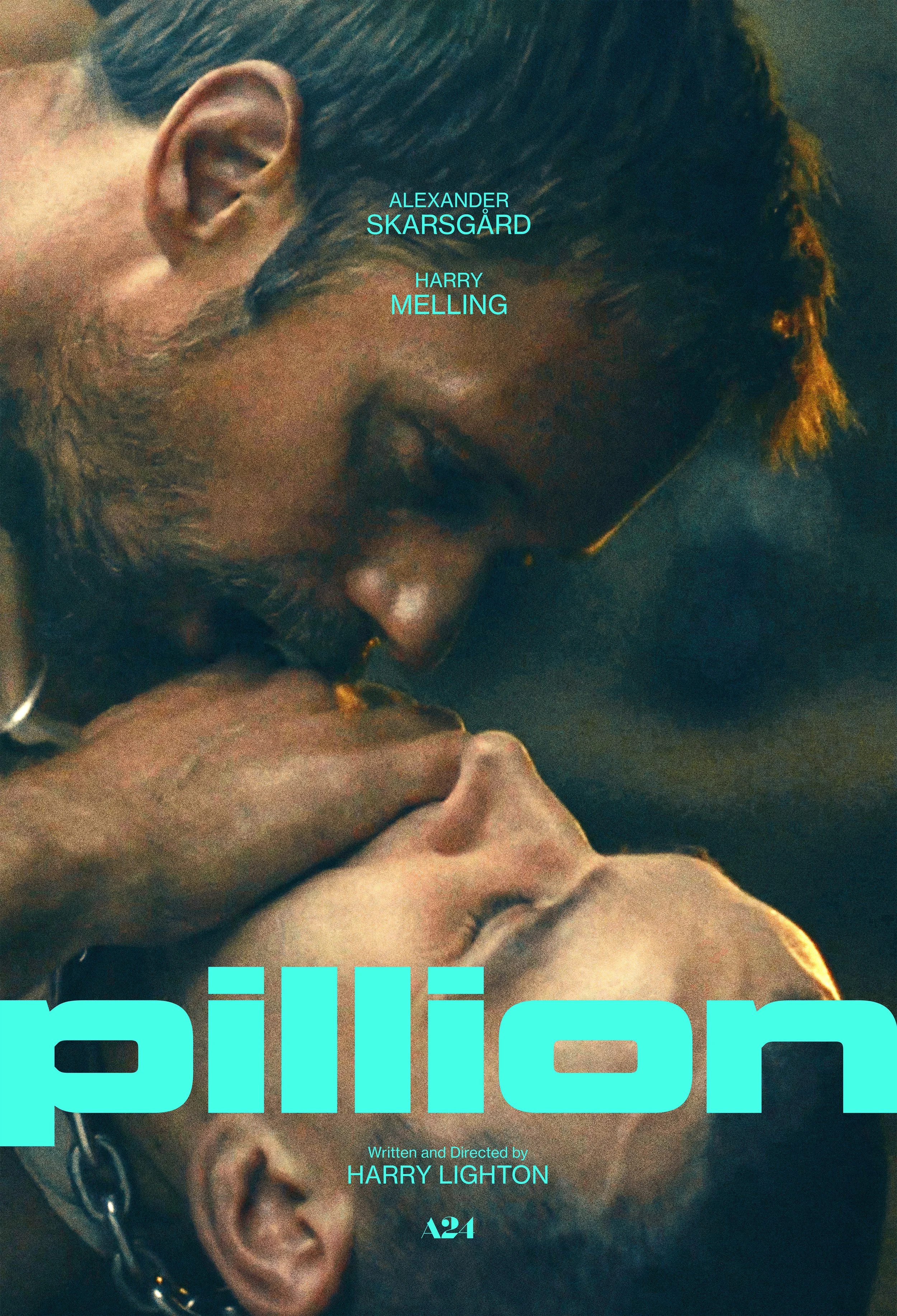
Image provided by A24
The Plot Lands the Plane
The thing about romantic comedies that annoys me the most is that the romance usually overcomes problems without actually addressing them. The couple passively agrees to ignore the problem, or one person has a dramatic overnight change that would never stick IRL. One reason I appreciated PILLION is that the happy ending doesn’t come from the romance itself.
When Colin finally asks for what he wants—“A day off.” Once a week. Once a month. Not a complete dynamic change, but a seemingly reasonable request—Ray says no. The next day, though, after a brief, fun rebellion, Colin gets what he asks for. It’s not a role reversal, which would be cheap and commercial, but this is the most stereotypical romcom moment in that it is a stereotypically perfect date. But it’s not what Ray wants. So, it’s their last date.
Closed-mouthed Ray actually ghosts Colin. It’s all too real—who among us has never been ghosted after a reasonable request? But it’s the dialogue, or rather lack of it, again, that keeps the story on track. Ray doesn’t talk about stuff. He doesn’t communicate with Colin. He just disappears.
Colin’s supportive father drives him around to look for Ray, but he disappears completely. If the film ended here, we could not class it as a “comedy.”
Yet Colin is better for having gone through relationship, even with its ending: he better understands what he wants now, and he lists his “one day off” a week as a non-negotiable on his new and effective dating profile. The film ends with another, new date. It’s pretty similar to the dynamic of Colin and Ray, but this time, Colin discloses clear expectations and limits.
We need more real love stories, now more than ever, and we always need special, specific love stories and clear communication all around, like in PILLION.
Perfect title, too: the meaning of “pillion” is the backseat of a motorcycle. Love it.
As for where to watch this romantic comedy, PILLION release date: playing in select theatres February 20, in major theaters February 27, 2026.
If you enjoyed this article, here are some others you might like, too:
—The Best Creative License in the New WUTHERING HEIGHTS Movie is Isabella Linton’s Liberation
—The Best Period Pieces to Watch this Winter
—What to Watch with Your Dad during the Holidays
