Is Christopher Nolan’s THE ODYSSEY Movie Really That Good? Yes, Explained
As a literature professor, I taught The Odyssey many times. My emphasis was on the plot, mostly with the goal to supply a generation of readers with the material for 1/3 of the western canon’s allusions. That’s not the case with Christopher Nolan’s film adaptation.
Rather than summarize this epic poem that you should have read in high school and college if you went, I’m going to assume that you have a working knowledge of at least the events in The Iliad and The Odyssey, but I’ll remind you of them as I go, too. Also, it should go without saying that I’m going to “spoil” this. As much as one can “spoil” media created like two and a half millennia ago.
I had many concerns going into The Odyssey film adaptation. I didn’t want the American accents. I didn’t want to watch three hours of CG. I didn’t want a butchered Siren Song. I didn’t want another movie glorifying war and warriors. TLDR: What could you possibly add to improve a millennia-year-old story? Why do you need to adapt it again?
But that’s the thing about an epic poem… after the actual events, whatever they were, The Odyssey was told and retold for between two to five hundred years before it was ever written down, and every single storyteller altered it for their audience. The epithet “Sing in me, muse,” wasn’t just for the bards to buy time while they collected their thoughts: it was literally asking for fresh inspiration on the same very old story. Best case scenario, the storyteller went into full trance-mode.
So, touché, lit professor. Retelling the story for a new audience is the nature of this beast. That is what happened for the next 2700 years or so, but this time in writing, and through translation.
All that said, this movie is a retelling of an ancient story for a new audience. The important things are consistent, but it interprets The Odyssey to an adjacent purpose. It provides a fresh perspective—plus a fresh medium.
Which book is the film based on? (Specifically: which edition?)
My biggest concern going in to The Odyssey film was that it would not honor the oral tradition of this narrative. Ironic admission, I know, from a person who didn’t want another retelling. (I believe my exact words were, “Poseidon better be blackout drunk in Ethiopia at his own festival when this show starts, otherwise, it’s not authentic at all.” More on that later.) But the movie does honor that tradition. Immediately, with the bard (Travis Scott) trying to tell the story to a great hall full of suitors—and getting shut down by Penelope (Anne Hathaway). But also throughout.
I let my students use any translation of the text when we studied it, but Christopher Nolan based his script on a recent translation by Emily Wilson. It’s worth noting that Emily Wilson’s edition is the first one published (in English) by a woman. (Let me be clear: I have not read this translation in its iambic pentameter, so I’m not sure how much of the credit goes to Wilson vs. Nolan regarding perspective, but, like I said, that’s the nature of it.)
Regardless, the fact that this story gives more women’s perspectives is indisputable. Several things I remember reflecting back on long after initially learning the epics of the Iliad and Odyssey were realized in his new film.
Let’s talk about Helen.
A quick recap of what The Odyssey is about.
What kicked off the Trojan War is that Helen (here, played by the great beauty Lupita Nyong’o) left Menelaus (the great beauty, Jon Bernthal) for the Prince of Troy, Paris (not pictured).
When I learned about this story, even when I taught it, I had it in my head that Helen willingly left her husband, Menelaus, for her lover, Paris. Under this assumption, I never thought a whole lot of Helen.
Now, looking back, I wasn’t sure about Helen’s motivation anymore. I asked a couple literature nerds whether I misremembered it, and the answer came back murky. One friend reminded me that in some translations she was under the influence of Aphrodite (and you can read Kyle Pinion’s film review here). Two others said it was unclear at best. But we all agreed that Achilles was gay—or at least, in a romantic relationship with Patroclus.
Now, knowing what I do about marriage being a contract (that point is consistent throughout time), and back in the Ancient times, marriage was mostly about consolidation of power… maybe Helen never wanted to marry Menelaus.
When I say “maybe,” I’m being polite.

Image from ELLE
Trojan War
Which made me ask, Who abducted Helen? Menelaus? Paris? Menelaus and Agamemnon? Choose all that apply, but another point of agreement among we nerds was that Helen was definitely reclaimed during the Trojan War, by both her husband Menelaus and his brother Agamemnon (Benny Safdie*).
Another friend mentioned that the allusion to enslavement and fetishism was a smart tie-in. Look, the whole internet got its ass on its shoulders when they cast Nyong’o as Helen. First of all, how dare you. Secondly, for those who believe themselves “literary purists” instead of just racists because Helen had “white hands.” Okay, even were that so, who’s to say the color of the rest of her? Also, this is an adaptation, and that “Helen of the white hands” is a buy-me-time epithet. Just like “dawn with her rose-red fingers” and “the wine-dark sea.” Yet no one is complaining about the ocean being blue.
At the very least, casting Nyong’o, who is Black, as Helen, expands her perspective for a contemporary audience.
To be clear: no, it is never mentioned that Helen nor Clytemnestra (also played by Lupita Nyong’o! And adapted to be her twin sister!) were enslaved. They are clearly wives, not slaves. At least, not in the sense that we think of it. But you saw what I said about marriage and abductions. The wives are never on equal footing with their husbands. Don’t worry: I’m coming back to this idea when we get to Penelope (Anne Hathaway).
In this adaptation, Agamemnon wants war not to get his sister-in-law back to his brother, but to take over the trade routes. Helen corrects Menelaus on this point.
Trade routes, motherfuckers. Go look at the trade routes from this era and tell me what goods they were trading.
As they say, they (the racism and misogyny) are there for those with eyes to see.
Which brings me to motherfucking Agamemnon.
The Monsters
Agamemnon
I mentioned one of my big concerns is that The Odyssey, like all the versions of the Trojan War and subsequent voyages home that I’ve heard, would really lean on the glory of war and warriors.
In my book (figuratively, although I have written books), a soldier can be sympathetic—especially one who is drafted, as was everyone in this film. Omg, especially Sinon (Elliot Page), whose story was heartbreaking—but warriors… usually, I’m like, “Idk, did you try talking about your feelings first?”
What I mean is, I hated Agamemnon from the moment I heard his name in high school. I mean, cool name, but then you’re going to sacrifice your daughter? To win a war? About commerce?
What I mean is, as even a wee fourteen-year-old, I was glad when his wife and her lover murdered him at his glorious homecoming.
As an aged 37-year-old, I was also glad when that happened. I also thought it was a smart idea to style Agamemnon like an unfeeling killing machine. But I was especially glad that his brother, Menelaus, was the one to tell Telemachus (Tom Holland).
The Trojan Horse
Speaking of, I know that Nolan likes to mess with time. That’s kind of his thing. But he really didn’t have to do much tinkering to the plot of The Odyssey for it to fit with his style. I actually wonder if (in addition to the epic storyline and massive scale and gorgeous production) might be why the adaptation appealed to him.
That said, true to (the written) form, when Telemachus visits Menelaus for recon on Odysseus (Matt Damon) and to avoid the suitors who keep trying to bait him into a fight, Telemachus is escorted to the literal right hand of the king. It’s Zeus’ Law that they have to treat strangers as though they might be gods in disguise.
I know this ideal was an actual pillar of Greek society, a big topic of The Odyssey, and very important to all the characters here, but, like, did Nolan really have to rebrand it to be so on-the-nose? It’s one of my few irritants at this adaptation. Tbh, the American accents didn’t even really bother me—though it would have been nice to have a few Greek actors in there.
Menelaus and Helen both recognize Telemachus pretty quickly, and Menelaus asks if he’s heard the story of the war. Telemachus has, of course, heard the songs. Menelaus asks if he’s ever heard the story “From someone who was inside?”
He doesn’t mean inside the story, not even inside the walls of Troy. Menelaus means someone inside the Trojan Horse.
Courtesy of Universal Syncopy
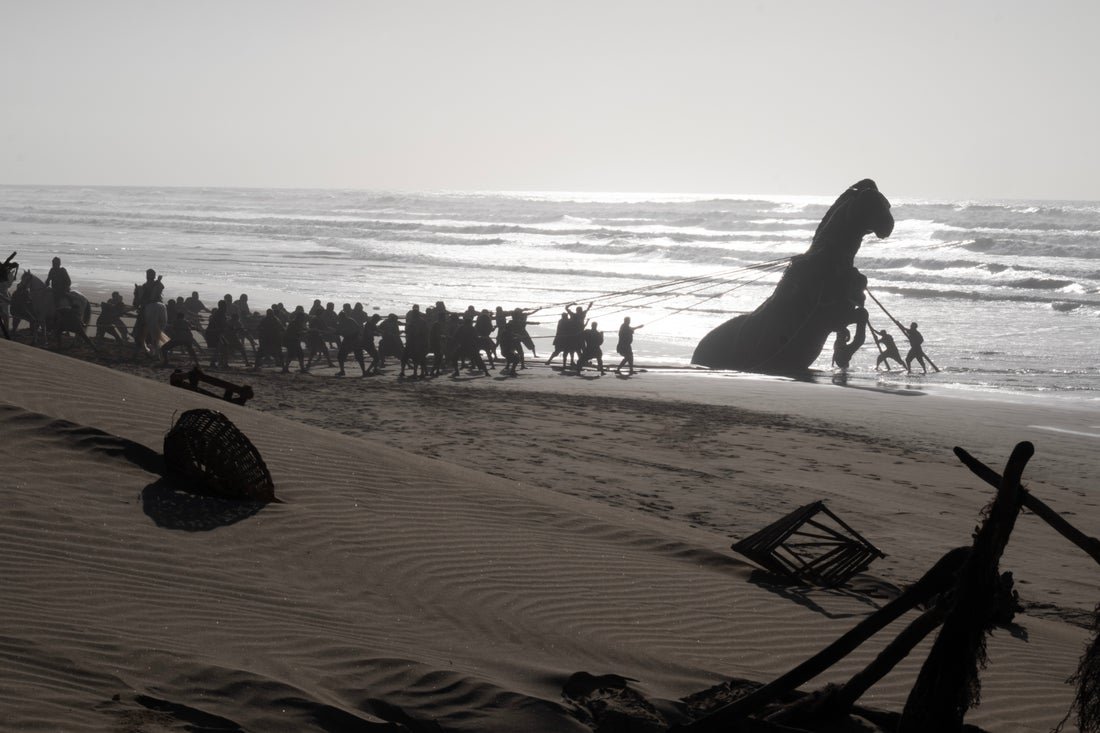
You might be wondering why the Trojan Horse falls under the category of “Monsters,” but you won’t be wondering when you see the movie: all the other adaptations have the gift Horse upright, on a sort of wheeled trailer, when it’s brought into the city walls. Here, the Horse is half submerged in the ocean—with the men inside it drowning—and then dragged over logs on its side before it’s tipped upright.
That sequence, of the Greek soldiers dying inside the Trojan Horse, is probably my favorite part of the whole film. But then again, I love me some folk horror.
That trial (to borrow a phrase from the Hercules myth) of sitting silently in the horse while their friends are drowning and getting stabbed when the Trojans check the Horse for inner contents… it’s the time when Odysseus mulls over what his “wisdom” had gotten them into. When he retells it later, at the end of the film, he realizes that he’s essentially overturned civilization by tricking the Trojans into accepting a “gift” and violating their home.
See? No warrior’s glory here, either, not even with the titular protagonist: even he, the winner and almost sole survivor, regrets his tactical aptitude. Instead, he mourns how he set the precedent for ignoring Zeus’ Law.
The gods
Speaking of wanderers being gods in disguise, where are the gods? The people are doing everything for them, blaming everything on them, but where are they at?
Yeah, Athena (Zendaya) shows up… but only to Odysseus, and not really. She’s a ghost. She’s a manifestation of a girl he watched beheaded.
In the written version of The Odyssey, the gods are very real. They have lines, they go in disguise, they get mad and jealous. In the film adaptation, although the gods are real to the characters involved, to we viewers, they’re just an ancient belief system. Actually, Odysseus kind of starts to feel that way, too. It’s a genius adaptation, to layer in that existential crisis.
The Cyclops, Polyphemus
For example, the first reason Odysseus homecoming gets delayed is because he and his crew pissed Poseidon off by blinding (and murdering?) his son. At least, that’s how it’s presented in the book. On screen, Odysseus says his men believed Poseidon had cursed them for murdering his son, Polyphemus (Bill Irwin).
Polyphemus is probably the truest monster-on-every-level depicted in Christopher Nolan’s The Odyssey. I mean, he eats the Greek warriors when they’re just chilling by the fire of his cave. Talk about violating Zeus’ Law, am I right?
He’s also a physical monster, both in his giant size and in his visage. He’s also a puppet, inspired by Francisco Goya’s Saturn Devouring His Sons, which is dope. Polyphemus’ appearance was one of my favorite interpretations of the book, too. Here, his “one eye” appears to be a genetic defect from centuries of divine inbreeding. Bravo.
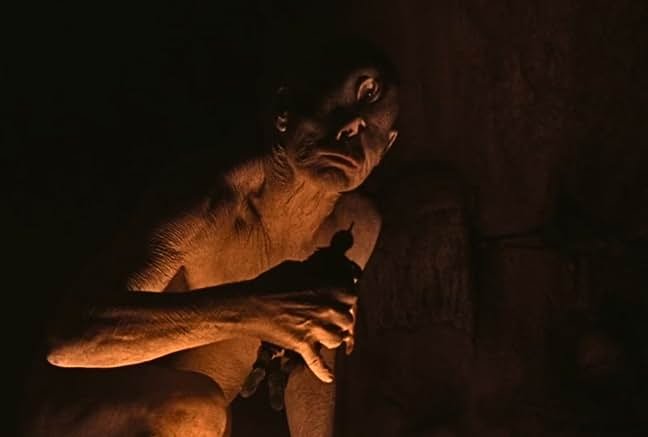
Image from IMDB
Calypso
Speaking of absent gods, the given reason for Odysseus’ entire crew’s death is that they slaughtered the cattle of the sun god Helios, even after they were told not to do it. In my reading, I assumed those soldiers were just kind of dumb. In the film, Eurylochus (Himesh Patel) says they remembered Teiresias (James Remar)’s prophecy, but they “chose to drown rather than starve.” I loved that Christopher Nolan drew that out—these guys are not stupid. They’ve been mentored (pun intended) by the wise Odysseus. They made their own destiny.
Nonetheless, Odysseus is the sole survivor who washes up on Calypso (Charlize Theron)’s island. I did think it was an odd decision to downplay that 7-year-long rape though. I know someone is going to argue with me here that they don’t even touch or kiss on screen, but Calypso did drug him with lotus flower for seven years. You can’t consent when you’re missing information, let alone when you’re high. And in case you missed the rape rhetoric, she even says in the film, “You were happy. You loved it.”
I guess the rape culture (along with the misogyny, et al) is also there for those with eyes to see.
Christopher Nolan actually leans into the horrific elements of this story in many other places, besides the Trojan Horse interior and the Cyclops… which brings me to Circe (Samantha Morton).
Circe… or the Sailor Pigs?
Circe (Samantha Morton) is one of the more famous moments that Odysseus gets waylaid, and although we might owe it’s current popularity to Madeline Miller’s book Circe, she’s also memorable on her own because Circe is a witch. She’s the one who turns Odysseys’ soldiers into pigs. Or, as she would say, she turns them into their true forms.
Although the sailors did not harm Circe herself, her whole justification is, they’re soldiers. They’ve done it before. And they’ll do it again if they have the chance. It’s not fair, but she’s probably not wrong. (I mean, you saw my predisposition earlier.) Based on the pillage of Troy we see in a later flashback, I can’t say her argument doesn’t hold. But the way Circe sculpts their faces from cinema-worthy ingenue to disgusting hybrid pig-monsters… very awesome-I-mean-terrible.
The Sirens
I’ll be honest: I was very skeptical that The Odyssey’s film adaptation would do right by the Siren Song. They’re also technically half-bird cryptids, not the sexy mermaids we’ve grown to associate with them, but back to the song. Honestly, how could one improve upon the Margaret Atwood poem? It says itself, of itself, “This is the one song everyone / would like to learn.”
Back when I was skeptical, I did not realize the music composer was Ludwig Göransson, and I did not expect him to use James Blake vocals. It was incredible. Chilling, accurate, and a motif of Penelope’s song. Ludwig Göransson understood the assignment. I stand corrected and impressed.
I also did not expect Odysseus to admit that the real lure of the Siren Song was the existential crisis: in this adaptation, the Sirens offer to undo your biggest shame.
Wise Queen Penelope
Remember back when Menelaus was telling his insider’s version of the war?
He tells Telemachus that Agamemnon’s son, Arestes, avenged his death by killing Clytemnestra and her lover. Telemachus says, “Wait, he killed his own mother?”
That line alone shows him as a stand-out guy, especially when Menelaus corrects him: “He avenged his father’s murder.” Subtext: Clytemnestra was avenging her daughter’s murder… that’d be Arestes’ sister. These dudes don’t value women at all.
Remember what I said about Helen, and how the wives are never on equal footing with their husbands? When she tells Telemachus good-bye, she gives a hurried apology: “Tell your mother I’m sorry for Troy.” I’m not really a crier, but that gives me water-eyes just thinking about it, Helen taking responsibility for all this hubris.
I’m not even going into the suitors, btw. Suffice it to say, they’re even grosser in the movie.
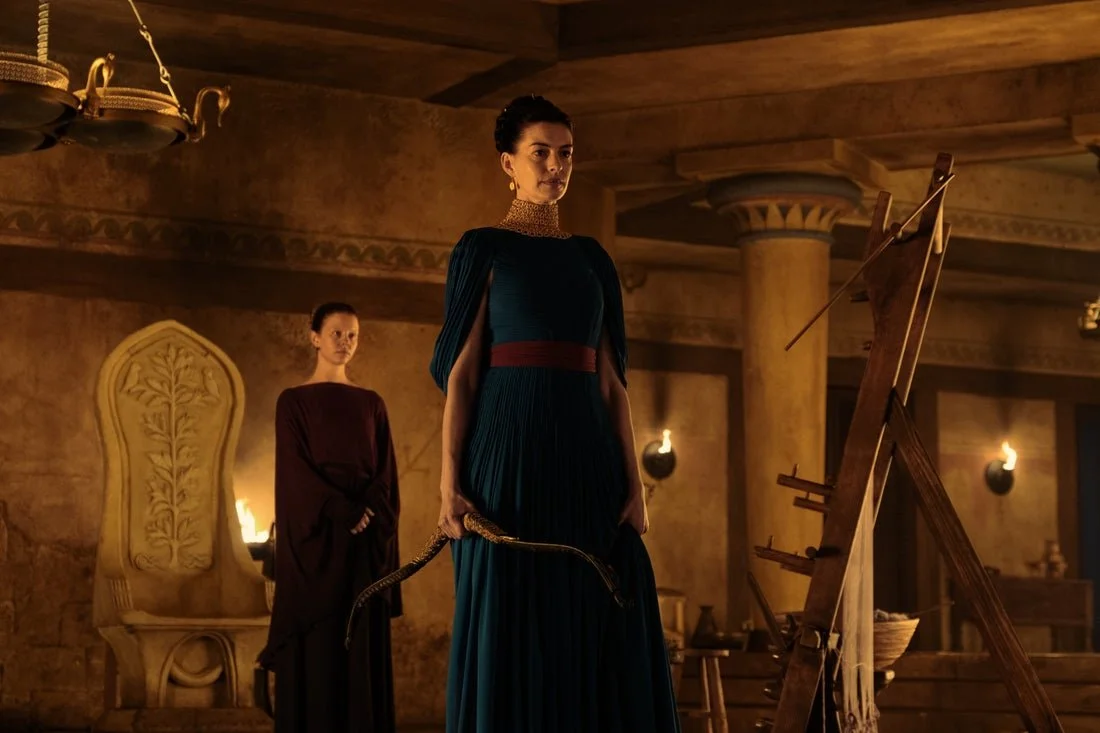
Let me get back to Penelope: her genius really gets to shine here—pun intended, again. We know from the book that she’s devised a way to keep the suitors guessing. She gives them a deadline of when she finishes her father-in-law’s burial shroud… of course, she’s undoing the day’s progress overnight, buying time.
We also know that it is she who tells the suitors she’ll marry whomever can string Odysseus’ bow and shoot it through all the axes, his fun little party trick, which was also rendered really fun to watch because it wasn’t Odysseus’ strength that allowed him to string that bow. It was his strategy. Same as with everything else at which he excels. (It’s like watching a tiny woman tear a phone book in half: she’s not stronger than you, she just knows how to do it.)
Courtesy of Universal Syncopy
In the books, we’re led to assume that Penelope picked up these lil tricks from Odysseus, but this film adaptation has me more inclined to believe that he picked up these brain-games from her.
In the biggest payoff monologues of the whole film, when Telemachus is trying to convince Penelope to just pick someone so the throne isn’t empty anymore, and then he can take over as soon as he comes of age, Penelope goes off on him. The throne has never been empty. For the almost twenty years of peace in Ithaca since Odysseus has been at war, wise Queen Penelope has been ruling from that throne. It’s never been empty: they just didn’t see her there because she was a woman. And honestly, until this adaptation, neither did I.
The Odyssey releases in theaters Friday, July 17, 2026.
If this story stuck with you, then you might also enjoy…
—Hatshepsut: Egypt's Forgotten Female Pharaoh, Re-examined
—The "Real" Witches of MACBETH
—The Long History of Toxic Cosmetics
