Legendary Folk Horror Retribution in THE DEATH OF ROBIN HOOD Movie (Explained)
Sometimes I see a film trailer and it is so made for me that I hiss under my breath, “Yessss.” Such was the case when I saw the trailer for The Death of Robin Hood, written and directed by Michael Sarnoski.
I love a folk hero deconstructed, especially in a prestige period drama. I also love hot grizzled old dudes fighting dirty. I love awesome costume, set, and sound design. And, above all this, I love folk horror.
If any of those niche interests resonate with you, you’re going to love this movie. But be warned: like the movie poster states, he was no hero. He was a murderous brigand.
What is The Death of Robin Hood about?
Set aside for a moment what you know about the legend of Robin Hood. By that, I mean, maybe don’t do too much research into the more contemporary retellings like Prince of Thieves(1991)and Men in Tights(1993).
Here’s the pre-spoiler synopsis / summary: Robin Hood (Hugh Jackman), some fifteen years after his killing sprees, is now an older—still very fit—wanderer. He rambles the mountains of northern England alone, maybe on the lam, brooding on his successes as a murderer and bandit. Robin seems to despair of never dying in a fight.
In one opening scene, a traveling girl asks him if she’s heard the stories about Robin Hood and his valor, his stealing from the rich to give to the poor, and whatnot. He says they’re just stories. Robin Hood never prayed a day in his life.
Little John (Bill Skarsgård) has meanwhile made a new life for himself as “Edward” the farmer, in which he married Margaret with red hair like “the setting summer sun,” and had a daughter.
Somehow, Little John’s true identity has been discovered, and a group of men seeking vengeance for deaths of their kin have commandeered his house, wife, and daughter. He needs Robin Hood’s help to free them. Robin agrees to help, but he seems to take no further joy in the violence. He even shrieks “No!” when Little John prevents his attacker from delivering the fatal blow.
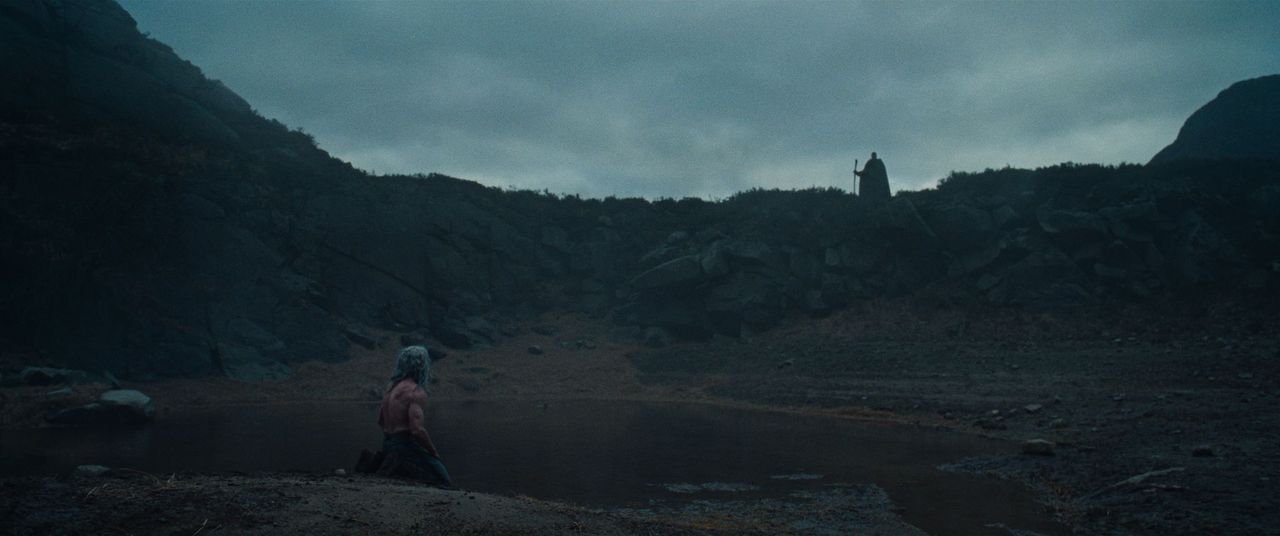
After harrowing wound cauterization, Little John drops the horribly wounded Robin Hood at the door of an island Priory, where the Prioress (Jodie Comer) will nurse him back to health against his will… and Robin Hood will have to reflect on all his atrocities.
If it sounds like Beowulf, that’s because it is: Robin Hood wants the heroic death in battle, so he goes in for one last hurrah. The difference is, Robin and Little John are too good. He doesn’t die. He has to reckon with his own violence. There’s no easy way out for him.
Our current film market is inundated with violent-daddy-saves-the-day themes—The Furious(2026)being the most recent; Taken(2008)being the most obvious. So, the fact that Robin Hood is coming to terms with being the worst person in the world and he doesn’t get to save the day with sudden violence-turned-altruism?
I say: good. Sit in the corner, and think about what you’ve done.
Credit: Aidan Monaghan
Courtesy of A24
Is Robin Hood a true story?
Historians and folklorists have debunked at least eight possible ways in which the legend of Robin Hood might have been a true history figure.
So, what is the real story?
It depends. While Robin Hood is not based on a book, the oldest known ballad depicting “Robin Hood and the Monk” was written in the 15th century. But that’s just what was written down. And what survived till now. The legend went back much further, and it’s still snowballing and morphing into new iterations now. Just look at this film.
[SPOILERS START HERE]
Michael Sarnoski’s movie The Death of Robin Hood is set in 1247 AD, the earliest time that historians can track the legend. That does mean, though, that a lot of characters who appear much later, in the 15th through 17th century printed broadsides, are not present. You won’t see Friar Tuck, nor any of the Merry Men save Little John. We also don’t see Maid Marian (not in person, though she is mentioned), nor King Richard the Lionheart, Prince John, nor even Robin Hood’s most famous nemesis, the Sheriff of Nottingham.
Don’t worry, though, there’s still plenty of folklore.

Credit: Aidan Monaghan
Courtesy of A24
Cast of Characters
All the following characters are present both in Death of Robin Hood and at least some original source material.
Robin Hood
The consensus is that Robin Hood, in the mythology, was a yeoman. In R.B. Dobson and John Taylor’s book, The Rymes of Robyn Hood: An Introduction to the English Outlaw, they say that a yeoman was distinctly and always considered a commoner. Not a knight, and not a peasant, but something in between. That class included artisans especially. The class distinction is important, because this was a yeoman story for a yeoman audience. Your boy was middle class.
Our “steal from the rich to give to the poor” narrative still resonates. I mean, why would they have named that stock app “Robin Hood” otherwise? Granted, that’s more of a “steal from the rich to give to ourselves” situation, but I think the logic still applies.
It’s also relevant because yeomen included military, in particular bowmen, and in almost every single version of the myth, Robin Hood is a skilled archer.
He’s definitely skilled in this film. I looked it up: it is not typical, when shooting an arrow, to aim for the eyeball. As with other weapons, a body shot is more likely to hit.
In this version, though, Robin Hood doesn’t have middle class values. He’s not rebelling against tyrrany. He’s just a violent criminal. An aged criminal, sure, a criminal who is reflecting on his deeds at long last, but he’s still a criminal. He’s hurt and killed so many people that he doesn’t remember them at all. He’s on the run not necessarily from the law, but from the survivors resorting to vigilantism for justice.
To recap, yes, Robin Hood has by this time been denied his heroic, retributive, or at least violent death. But, he is over it, and he’s ready to die.

Credit: Aidan Monaghan
Courtesy of A24
Little John
In the popular mythology, Little John is Robin Hood’s right-hand man among his Merry Men. In most iterations, he meets Robin Hood on a tree bridge, where they fight, and much of the time, Little John wins. He gets his name from being seven feet tall.
In the film, we don’t learn how they met—not directly, at least, and not on screen. It’s clear that Robin Hood is a good decade or two older than Little John (Hugh Jackman is 22 years older than Bill Skarsgård, FYI), but we only get a hint of their relationship in the very last scene, when Robin Hood is on his deathbed, telling the story of her Papa to Little Margaret.
And he tells it slant, to put it mildly. Robin Hood tells her a folk hero version of her father, but he concludes it by saying she should never, ever tell anyone he was her father. I mean, we’ve seen how this feud for bloodlust plays out, and Robin Hood is, at the very, very least trying to save Little Margaret from this cycle of violence.
Then Margaret asks, “Why were he called Little?” (Thick Yorkshire accents throughout, I should mention—would have loved subtitles, especially in the windy, action-packed beginning.)
Robin Hood then reveals that John was “little when I found him.”
I confirmed my hypothesis in the film’s production notes, in which writer and director Michael Sarnoski says, Robin Hood “was using these child soldiers, including Little John, to help him murder and steal.”
So, that element alone frames the monstrosity of Robin Hood out pretty well.
Little John is also known for using a quarterstaff as a weapon. When Robin Hood examines the sewn-up eye socket of Arthur/Godwin (Noah Jupe), he recognizes the weapon used. And he understands that Godwin has been sent on a vendetta to avenge the men that Robin and Little John murdered in his family… which is all of them, including that first little boy he shot through the eye with an arrow.

Credit: Aidan Monaghan
Courtesy of A24
The Prioress
Back in the days before the Church of England, when England was Catholic (a wild throwback, imo), they observed the Catholic hierarchy. That means that a “Prioress” is a nun in charge of the administrative and spiritual leadership of a religious house, in this case, the island Priory. In case you (like I) needed a refresher.
This Prioress is also a skilled healer. In the film The Death of Robin Hood, Little John drops him at the Priory door after nearly dying in battle. In the Early Modern English ballad from at latest the 17th century, by the same name, Robin Hood goes to the Priory of his own volition, specifically to have his blood let.
It was a common practice at the time, bloodletting, and it was intended to balance the four humours. That’s as specific as I’ll be because, as we know now, blood letting and the humours are not supported by scientific theory.
In the ballad, “The Death of Robin Hood,” the Prioress betrays Robin. For reasons unclear, the Prioress, Robin Hood’s cousin, lets too much blood and tries to murder him. He has to summon all his strength to blow his horn and summon Little John, whom he then tells to shoot an arrow. Wherever it lands, he wants to be buried.
In The Death of Robinhood movie, things shake out a little differently. Hold this thought because I need to introduce another character for my next point to make sense.

Credit: Aidan Monaghan
Courtesy of A24
The Leper
From what I can tell, the Leper (Murray Bartlett)—unnamed until on his deathbed, in homage, I suppose, to the intense ableism of the Dark Ages—does not appear in the original source material. At least, not in a way where this character seems to be a direct adaptation.
Apparently, bandits used to disguise themselves as lepers. It makes sense. No one wanted to come near them because they believed leprosy is (yes, it’s still a thing) contagious. (It is, but not to an extreme degree, and it’s nowadays very treatable).
Of course, the main draw for the bandits was that the bandages obscured their identities. I mean, did you know that was Murray Bartlett in there? What a hero, to allow his beautiful face to be covered for the duration of this film. I sound sarcastic here, but I mean it.
This seems like a good moment to exhaustively praise the costume design. The attention to detail here, from the homespun cloth to the heavy furs to the stitches on Arthur’s eyepatch… the costume (Lorna Mugan) and set design (David Lee) made me really grateful for the extended shots that seem to slow down the action for other critics. Not me. I love it when we can linger so I can appreciate the artistry.
The Leper is actually one of the most physically able people at the Priory. He mans the ferry to the island and works in the orchard. Despite the nerve damage.
The Leper is not a bandit, but on his deathbed, unwrapped to expose his severe disfigurement, he does reveal his identity. He’s Guy of Gisbourne. Depending on the story, he’s Robin’s main competition for the affection of Maid Marian. Sometimes he’s a contract killer with Robin as a mark. Often he’s the second to the Sheriff of Nottingham (Robin’s main adversary).
In Death of Robin Hood, the Leper tells Robin Hood he knows who he is. Then he asks if it’s true that he beheaded Guy of Gisbourne. Robin says that person doesn’t exist, but he beheaded plenty of other people.
The Leper tells the true story. Robin killed everyone else, but he only took Guy’s ear. Possibly because he was a worthy adversary. He told Guy, “in another life” they would have a drink together. And now, lucky them, they’re in another life.
He makes Robin promise never to reveal that he is Robin Hood to the Prioress. Because she knows, even if Robin doesn’t remember, that Robin Hood burned her husband and children alive.

Credit: Aidan Monaghan
Courtesy of A24
Naturally, a monster like Robin can’t keep it to himself. He certainly can’t honor the promise he gave a dying man, and he definitely can’t spare inflicting even more pain on the woman who’s done nothing but help him.
NGL, I thought she was going to bleed him to death like she does in the ballad, but that would give him a vengeful death. That might allow the viewer to read his “telling the truth” as virtuous. Even atoning. Which it is not.
No, instead, this woman who has (probably) taken a vow to do no harm, he has her assist in his suicide. While he tells a folkloric version of events to Little John’s daughter, Margaret, while she’s retraumatized by watching him die.
Could one interpret this as breaking a cycle of violence? Sure. One might even support that argument as well as Matt Goldberg does here. Seriously, he almost changed my mind. It’s good.
For my part, this is Robin Hood the brutal vigilante getting his just desserts.

Credit: Aidan Monaghan
Courtesy of A24
Is The Death of Robin Hood a horror movie?
So, as I aforementioned, Robin Hood is a bandit. He murders and steals, but in the first third of this movie, he mostly murders. Starting with the traveling girl who tries to avenge her family’s murder by killing Robin Hood. She fails, and he stabs her in the neck many times before finally, fatally driving the knife through her temple. That’s how the movie starts.
Yes, The Death of Robin Hood is a folk tale deconstructed… but in this interpretation, Robin Hood is the villain. The first third of the film has some of the grittiest, goriest fight scenes I’ve ever seen onscreen: you get to be extra visceral when it’s hand to hand combat, even more so when people die by bludgeoning.
While the purpose of this film is not to scare the audience, I would definitely call it horrific. The prosthetic team, Clare Ramsey and Josh Weston used almost completely practical effects. From the build of the Leper’s body and face to letting blood from the vascular forearm of a Hugh-Jackman-duplicate prosthetic. So when a jaw gets ripped out, for example, it might not be the man’s actual jaw, but it’s actual something.
In one red carpet interview, A24 asked Hugh Jackman what his favorite fight scene was to shoot. He chuckled and said,
“I’ve got to tell you, these were the hardest action sequences I’ve ever done in my life. I’m thrilled, I’m proud of them, [and] they were not enjoyable to shoot. They were meant to be brutal. They were meant to be violent and unsettling, and they felt a little bit like that doing them, so…”
A quick internet search says the film is “action/adventure” or “period thriller” genre. I suppose it is. But if this was a different medium, say it was in book form, I would have no trouble at all immediately classing it as Folk Horror.
My favorite genre.
The Death of Robin Hood releases in U.S. theaters Friday, June 19.
If this story stuck with you, then you might also enjoy…
—Spine-Tingling Folk Horror to Read This For Autumn
—The "Real" Witches of MACBETH
—LORD OF MISRULE Director William Brent Bell On His New Folk Horror
—7 Otherworldy Horror Books Inspired by Gaelic Folklore
