I must admit, it feels like the married couple Alex Huston Fischer and Eleanor Wilson (whom the cast called “Al and El!”) wrote and directed Wicker (2026) with me, specifically, as their target audience. Granted, at the mere announcement of the film, the internet lost its mind in the fantasy. Even Ikea got on board.
What is the Wicker (2026) movie about? Premise/plot summary
When the ostracized and smelly Fisherwoman (Olivia Colman) grows tired of her town’s ridicule and her own loneliness, she travels out to the Basketmaker (Peter Dinklage) with a special request: make me a husband out of wicker. He tells her to be at the chapel in one month, where her new Wicker Husband (Alexander Skarsgård) will marry her.
The Wicker Husband is basically a masculine Galatea in that the whole town is absolutely entranced by his beauty and sincerity, but they also grow wildly jealous of his kindness and his unflinching love for his new wife.
Official trailer for Black Bear’s film WICKER (Alex Huston Fischer and Eleanor Wilson)
What is Wicker (2026) based on?
Wicker is based on Ursula Wills’ short story, “The Wicker Husband,” which reads like a fable or fairy tale should. Fairytales and fables are notoriously tonally minimal with archetypal place-holder characters—that’s part of their style. And this fairy tale is excellent.
But adapting fairy tales to the screen often fails. That ambiguity does not typically read well in film. Not so, here. Somehow all the characters feel incredibly authentic, from their interactions with each other, to the folk practices, to the village itself. As a writer, it is not very often that I don’t have any notes about a script, but here, Alex Huston Fischer and Eleanor Wilson have created a perfect adaptation.
Don’t mistake me: faithfulness to the source material does not an excellent screenplay maketh. Not even when the source material is excellent. Page and screen are two very different media.
Here, the plot follows the original fable almost point-for-point, but the screenwriters beautifully weave in B Plot and character development to inform the actions of fairy tale archetypes. Not only is the result hilarious, but it feels authentic: these characters feel like real people, and their town feels real. The fullness of the world is evidenced best by some of the charming folk elements.
Rituals in Wicker
Social customs are imperative for world building, and they’re even more crucial in a story that hinges on the love life of an outsider because we have to know the status quo before we know who’s not adhering to it. Wicker knows that. No detail goes unexamined.
The script keeps the epithets from the source material, which refers to men exclusively by their professions, and women by their relationship to the men. So, a man would be called “Inn Keeper,” a child “Doctor’s daughter,” a woman, “Tailor’s Wife” and so on. Except for, of course, the Fisherwoman, the only woman referred to by her profession—because she’s the only woman who has a profession, and her parents are long dead. This distinction sets her apart at first as pitiable for her loneliness, but then, because she acts on her own agency, enviable because of her independence.
The superstitious gestures to ward off bad luck also color the personality of the town. Like when the Inn Keeper’s Wife (Emily Lloyd-Saini) helps the Bottlewasher’s wife (Marli Siu) ward off bad luck by instructing her, “No, it’s not a good omen… touch your biggest tit! Touch your biggest tit. (It’s that one.)” The fullness of this world makes the viewer believe in it, and when the restraints and expectations of the society are clearly established, the stakes are raised, and the intentional flouting of the rules gets rewarded.
Speaking of tradition, almost all original fairy tales and fables, much like Classic and Shakespearean dramas, end in one of two ways: they are either tragedies, which end in death, or they are comedies, which end in marriage. You know the stock ending, “They lived happily ever after.” Well, that traditional ending is kind of where Wicker starts. So from the very beginning, the film observes the traditional narrative device but then inverts it.
Wicker’s whole premise revolves around what the Fisherwoman calls the town’s “precious rituals.” Especially the most ceremonial of ceremonies, the wedding.
[SPOILERS START HERE]
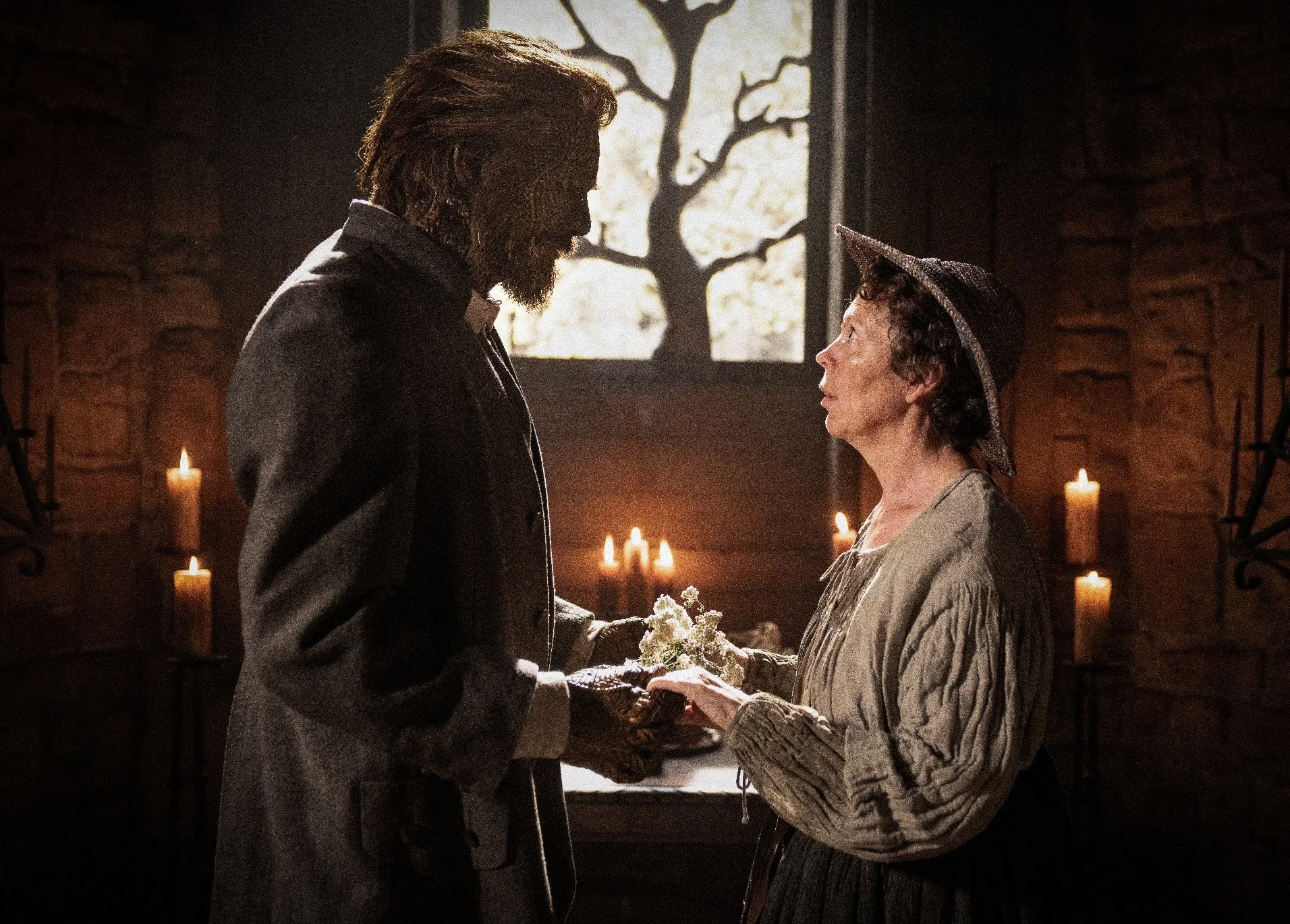
Courtesy of Black Bear.
Wedding Preparation
Ironically, we see the Wicker Husband doing preparations for the wedding, not his bride—our first inversion of expectations. He goes door to door asking, “Lend me…” starting with the Tailor (Nabhaan Rizwan): “Lend me a suit. I am getting married tomorrow, and I cannot go to church naked.” He recites this refrain to the Shoemaker (Scott Alexander Young) and the Inn Keeper (Kiell Smith-Bynoe). That repetition keeps with the repetition of oral traditions—that’s how fairy tales usually originated, as oral traditions. The refrains make the story easy to recall on the fly, so it’s a style resultant of practicality.
The Wedding Ceremony Itself
Anyone who has ever been married or been to a wedding knows that people still put too much importance on the ritual of it, but the way weddings unfold tells so much about the expectations of their society. We witness a wedding ceremony toward the beginning of Wicker, and even the vows are rendered ridiculous, both in their actual promise and in the way they are phrased: the officiant proclaims that “together we bid these here betrothed not to do the baddish thing but to do instead that whench [sic] is goodish. To be goodish is good.” Lol wut—and yet this sounds a lot like some nonsense I’ve heard people swear to in their vows.
Then, the Bottlewasher says, “With this collar,” yes, in this town, rather than sliding a symbolic wedding ring onto the bride’s finger, the custom is to clamp a collar of domesticity around the bride’s neck, trapping her veil in it until it looks like an asphyxiation device, “I take thee as my dutiful bride.” (“Love, honor, and obey,” anyone?)
And the Doctor’s Daughter with glee replies, “I accept this collar as a symbol of my lifelong duty.”
This absurd ritual later highlights how uncommon the loving marriage between the Fisherwoman and the Wicker Husband must be to the villagers. When the officiant asks the Fisherwoman and Wicker Husband for the collar, the Fisherwoman dismisses the request matter-of-factly, “Oh no, we won’t be needin’ that,” and returns her attention to the intense, devoted gaze of the Wicker Husband.
Other moments equally satirize some rituals that are still in effect at contemporary weddings, namely, the ever-cruel “bouquet toss.”
The Wedding Reception
You know the drill: all the unmarried women—no matter their age or willingness—get herded to the dance floor and have to fight to catch the bride’s bouquet when she throws it over her shoulder. It’s humiliating. Stop doing it.
The folk version written into Wicker is familiar, but a little more palatable because of its intricacy. The Tailor’s Wife (Elizabeth Debicki) and her sister, the soon-to-be bride, purchase a basket full of woven eggs at the market from the Basketmaker. At the right moment during the wedding reception, all the eggs are individually shaken, and the woman whose smoke plumes out purple is the next to be married. The egg explodes purple on the Fisherwoman, and she gloats a laugh at the spiteful village women, “hllw!” That’s how Olivia Colman said the laugh was spelled in the script—yes, the writing was apparently that detailed!
The Tailor’s Wife tells the Fisherwoman there’s “no shame” in living out her remaining days alone—in saying so, she absolutely intends to shame her, but the Fisherwoman responds that “Love seems more a burden than a prize.” Based on the relationships modeled around her, no one could do anything but agree. The Inn Keeper’s Wife (Emily Lloyd-Saini)—retorts, “Who said anything about love? The eggs only premonish a husband,” which implies that it’s expected for the marriage to suck, supporting the Fisherwoman’s idea.
In a later scene, the Inn Keeper explains, “I share my pillow with five little heifers. [My wife] wouldn’t hear [my words of gratitude] over the endless melody of toots. Don’t take your childless days for granted, as I did.” And then the Inn Keeper, Bottlewasher, all the men there make the gesture of throwing something over both shoulders for good luck. They all say “hear, hear,” confirming that marriage is equally as burdensome on the man’s end.
(Also, a moment for the diction and syntax of the dialogue in this film, please—what excellent consistency, yet comprehensible to contemporary audiences and hilarious in tone. Beautiful work.)
The Wedding Consummation
It's not even out of spite that the Fisherwoman flies in the face of the Village’s expectations. The Wicker Husband does not have the qualities that the men in the town show—or that convention allows them to show. Because he has no past, he has no presumptions. He is simple and sincere throughout, which illustrates the power of societal pressure… or absence thereof.
The first moment his character really shows happens when during the marriage consummation. The Fisherwoman gives him the tour of her cottage, including “the table,” and “the stove. Uh, there’s only one bed. I didn’t really think that through. I can sleep on the stool. I’ve done it before. It’s fine.”
He says nothing, but they inch their way toward one another, and then in a cartoonish sweep, he pulls her on top of him onto the single bed. He asks then, “How is this?” The Fisherwoman is clearly surprised, what with the hearsay of the blandness duty of marriage, but she responds with shocked excitement, “Oh. Yeah. Approved.” It reads hilarious when juxtaposed with the uptightness of the village, and it sets a different tone for their actual marriage.
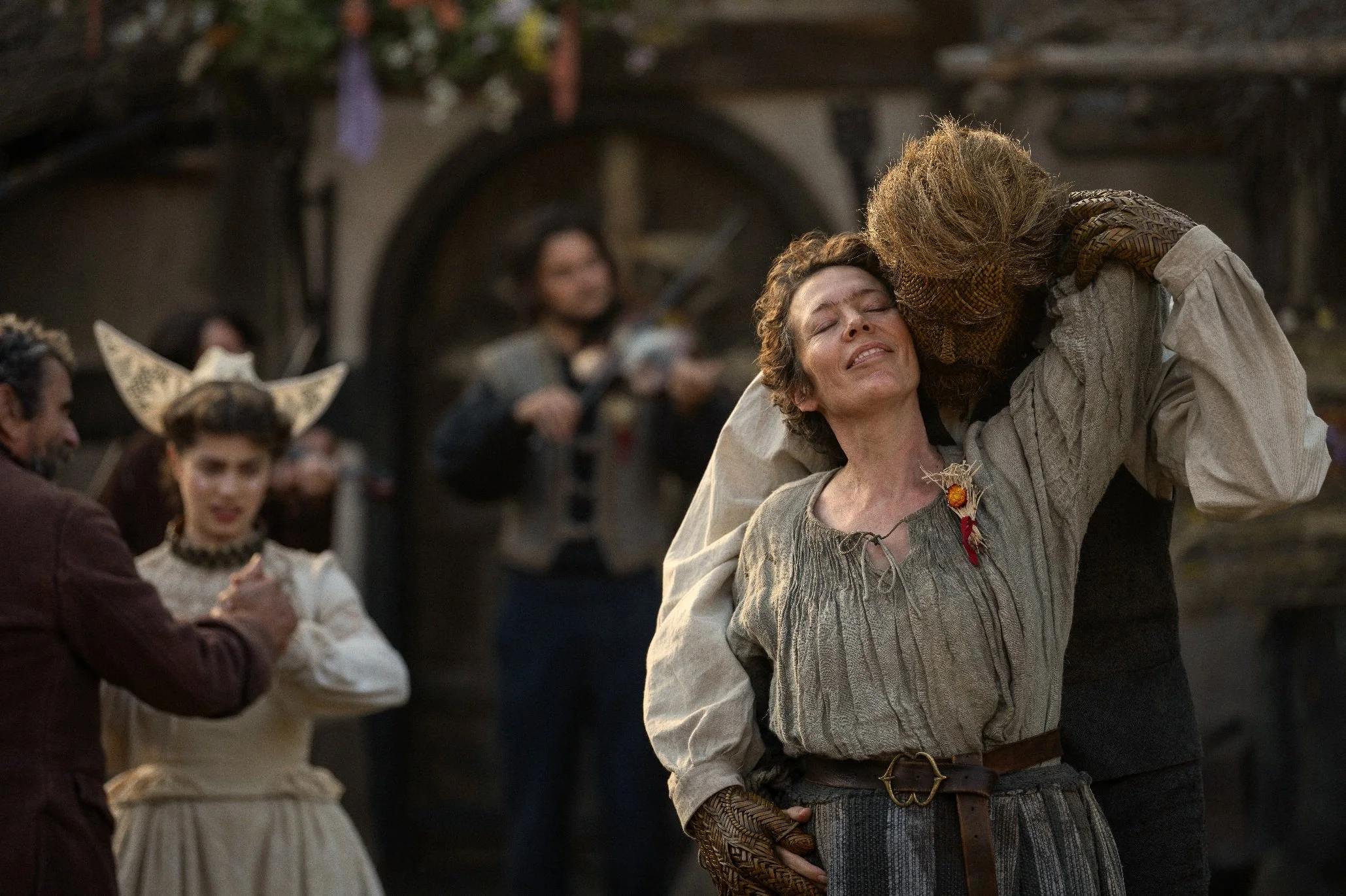
Courtesy of Black Bear.
The Wedding Dance
A few other wedding reception rituals get delightfully, discreetly mocked in Wicker, like the chicken dance. Here, the partygoers dance to a beautiful folk-sounding song that has, by incredible composer Anna Meredith’s own admission, “this horrendous time signature thing that keeps getting more and more county. I was worried the cast were going to hate me because it has many numeric properties.” Can attest: it is impossible to count in the moment—it took my drum corps husband three watches to pin down the meter, which changes every measure. Still, it sounds like an authentic folk song. I used to practice belly dance, and although Eastern European music is some of the most beautiful instrumentation to dance to, it has no problem telling Western music’s typical 4/4 time signature to fuck off. I respect it.
During the impossible wedding reception song—seriously, Anna Meredith said she sent a cheat sheet of how to count it along with the song itself to the directors—all the couples (all of whom are cishet, I noted), the choreography seems to imitate different mating rituals. At one point, the man prances around his partner like a rooster, and at another, the man beats his chest, all while the woman slips away from him.
The Wicker Husband barely tries to imitate what the villagers are doing. He leads their steps vaguely, but their dance evolves into romance, every turn focusing on the body of the other. They are clearly obsessed with one another, and by just two measures in, they do not care whether they stand out among the crowd. That irreverence incites extreme jealousy (well, sadness presented as jealousy) in the village women.
More Reception Games
In parody of… I’m guessing the garter toss? the groom plays a weird version of Pin the Tail on the Donkey in which a donkey eats a carrot-dick out of a jock strap/strap-on harness. Maybe my favorite example of simple sincerity clashing against absurd tradition to comedic effect: when the Butcher (Phil Daniels) wears the carrot strap-on with his hands bound behind his back at his own wedding, the Wicker Husband gives him his best wishes. He reaches out to shake hands (which is impossible), and says, “May your marriage be as full and affirming as ours.”
The Marriage Itself
That a couple meets each other for the first time on the day of their wedding is not uncommon—as we see with the marriage between the Butcher and his new wife—but the Wicker Husband’s admiration of his wife is uncommon. Once, when at the inn’s bar, the Bottlewasher (Gustav Lindh) asks the Wicker Husband why he fixes the cabin roof and all that. He offers, “Does she wear you down with her nagging? Is that it?” The Wicker Husband replies simply and sincerely again, which again reads hilarious when juxtaposed with the machismo of the village, “It makes her happy. And then I am happy. And then, the bed needs to be fixed.” The Baker (Ben Ashenden) spit-takes, and I almost did, too.
In Wicker, the clothes make the man. Kind of.
During the press junket, Olivia Colman mentioned one element of the costuming that I missed despite screening Wicker twice. Each of the two brass collars shown are engraved. One has boobs all the way around. The other has uteruses. (Not to make it about me, but I might actually wear that kind of collar.)
That’s just one example of the costumes singing in Wicker. The Fisherwoman always flies in the face of convention, intentionally or otherwise, from refusing a collar to two things the Bakers notice after her marriage. “Thanks for noticin’ all my adornments today,” she replies not exactly sarcastically after the Baker’s Wife (Ella Bruccoleri) asks about the rhododendron in her hair, if she just felt like a “garnish,” and the Baker notices the board attached to the bottom of her shoe. The Fisherwoman has one leg shorter than the other, and her husband made her a kind of lift to help offset her limp. “My husband made that for me,” she says. And then she adds an innuendo, “Straightened me right out!”
The Fisherwoman gets married in her regular, fishing clothes, as well. She eventually commissions a “Persimmon” colored frock from the Tailor, but she wears consistently utilitarian costumes throughout. The other women’s wedding gowns, though. Wow. The production notes say that costume designers András Dániel Tóth and Godena-Juhász “drew primarily from English, Flemish, and Hungarian traditions—specifically, the bridal headpieces with their voluminous layered veils were inspired by Hungarian culture.” I totally understand why the Fisherwoman does not wear one of these ensembles, but I would have loved to witness more of them onscreen.
I won’t go into the details of the Weta Workshop’s costume for the Wicker Husband because that has been detailed exhaustively elsewhere. I’ll just applaud its detail and the accomplishment that they made a wicker body very sexy. Or, rather, in the zeitgeist of Wicker, the Basketmaker made the Wicker Husband body very sexy.
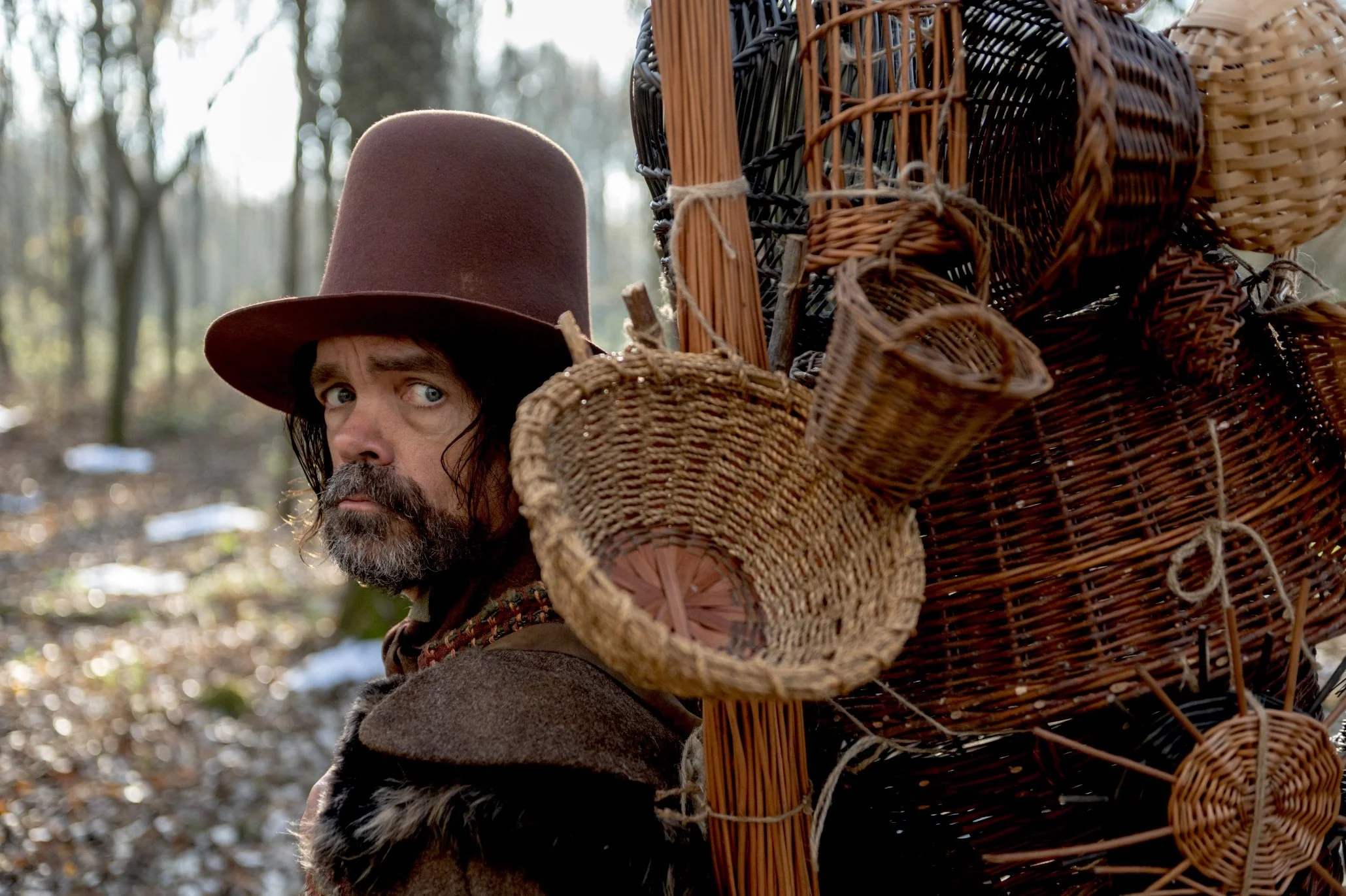
Courtesy of Black Bear.
Basketmaker as Creator
It’s impossible not to see a parallel between the relationship of Basketmaker and Wicker Husband to Frankenstein and his monster, yet the Basketmaker is much more humane than Dr. Frankenstein. He embodies the fable’s archetype of Creator, but it’s not just the act of creation that inspires him. “Nature provides,” he says. “I merely augment.” The Basketmaker is the most introspective character in the film, and as such he takes responsibility for his actions more than anyone else.
He lives apart from the Village, reviles them as “blind moles,” yet he travels there to market—and it appears he travels elsewhere, as well, by his trade-route-appearing dress. Because he exists outside of the town, for reasons undisclosed, he does not participate in their groupthink. In fact, he weighs each creation before he undertakes it.
After agreeing to make the Wicker Husband, the Basketmaker closes the door on the Fisherwoman and he recites a nearly Shakespearean monologue. He says, “I’m astonished I have not yet commissioned myself for the task. But a gift to the self is not noble. Nor lucrative.”
He then goes on to ask himself about the repercussions of creating this husband. He considers that the husband would be for the poor orphaned Fisherwoman whom the Village treats so coldly, reflecting, “Would I have helped her had I been one of them? No, perhaps not… my gift is my craft, my ability to create an elegant vessel. In this case, a man. A perfect being. A tool to re-hew harmony of human nature. His character will be his own to choose, of course. For who am I but a simple master Basketmaker?” It might sound like he’s recusing himself of the repercussions, and perhaps he is, in this moment, but that reflection on his intent marks more introspection than any other character displays.
The next villager to visit is the Bottlewasher’s young widow, who asks him to make a baby for her, and he agrees. Again, when he closes the door, he soliloquizes about the undertaking. “A babe. An art appointment, no doubt, and her manic dispossession does make me question her ability to care for a child.” It seems as though he compares her desperation to that of the Fisherwoman and finds her wanting, but then he again appears to recuse himself of responsibility. He says,
“Oh, but who am I to decide who is worthy of a child’s love and who is not? Plenty a wicked crone mother has raised a good child who became good man. I’m a good man! Thank you, mummy. No, thank you, mummy. This child might very well be the thing to save her, to give direction to her life. For nothing quite restores the soul quite like gazing into the innocent eyes of a neonate. Or so I’m told… Yes, an honor. To make a woman into a mother. An act I could never—or rather would never—do in the traditional way. A man’s work is greater than the man himself. Sacred, even. Especially this.”
It’s one of the more beautifully written passages, and the Basketmaker, as a Creator archetype and perhaps the only character with any formal education, is the only one to have any soliloquy, let alone three. When he finds the half-burned Wicker Husband in the woods, he actually does quote Shakespeare! In particular, he quotes from Titus Andronicus, when Marcus finds his niece Lavinia in a similar situation, wandering the woods with her tongue and hands cut off. He quotes, “If I do dream, would all my wealth do wake me. / If I do wake, some planet strike me down, / That I may slumber in eternal sleep!” (Act II, scene vi) The Basketmaker seems to realize in that moment that his Creations are his responsibility, at least in part, and he tells the Wicker Husband to “Come, come.”
Ending, Explained
The Basketmaker also catalyzes the film’s conclusion. When he comes to her home, he asks her, “Why do you care for the child but shun your own husband?” And when he sees her remorse and atonement for harming her innocent husband, even though she does not know he is innocent, so he mercifully tells her, “Woman, do you think baskets are born?” The Basketmaker sees only her regret, not her understanding, so he gives her another mercy. “I did not build you some fuckable furniture. His life was his own. Despite my attempts to redirect his affections, if he said he loved you, it’s because he did.”
This stylistic decision, to give the Creator the most self-awareness, in my view makes the story truly his narrative: he’s there at the beginning, nothing would have happened without his doing, and he’s the one who repairs the damage at the end. “Fisherwoman,” he says, “despite your utter senselessness, I fear I played a part in this calamity,” and then he atones by reuniting the whole family.
Plus, in true fairy-tale fashion, he poses a sort of riddle to the Village, stating that whomever gives him the best retirement gift should get a Wicker Woman as a prize. Naturally, seeing how perfect, beautiful, and eager to please the Wicker Husband was, they all give away the best of their earnings.
And, again in true fairy-tale fashion, wishes never play out the way you expect them to: if something seems too good to be true, that’s because it is. The Wicker Woman is made of Blackthorn, durable and sharp. The kind of wicker this Village deserves, at least in his estimation.
The last frame watches the four of them (Basketmaker, Fisherwoman, Wicker Husband, and Wicker Child) all leaving the town in a cart full of the Village’s best, presumably to start anew under the provision of their Creator and father-figure, the Basketmaker.
Conclusion
When asked during the press junket, how did the fairy tale short story impact your performance, the cast said that they did not even read the short story in preparation. I was shocked at that response until Olivia Colman explained returning to the source material was “the sort of thing you do when the script is flat.” If you watch the full interview, then you can hear verbatim, the actors’ inspiration is always the script. That’s the power of good writing and dedicated writers.
Wicker releases in U.S. theaters Friday, October 23.
If you liked this essay, then you may also enjoy these…
