Catherine Parr Was King Henry VIII's Last Wife
She's the subject of a new historical film, Firebrand.
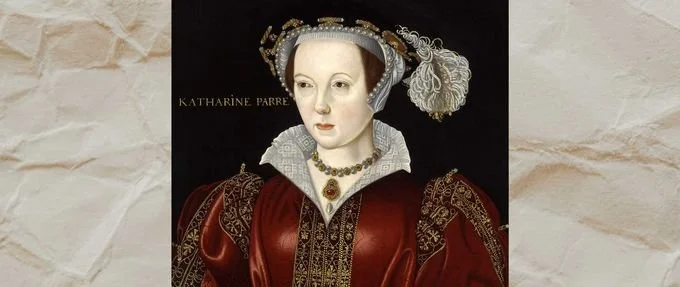
Photo Credit: Wikipedia
Karim Ainouz’s new film Firebrand offers an exciting if somewhat revisionist history of Catherine Parr, the sixth and final wife of King Henry VIII. It’s an adaptation of Elizabeth Fremantle’s historical novel, Queen’s Gambit, with Alicia Vikander and Jude Law portraying the married leads.
Though Catherine’s life outside of the three-and-a-half-year royal marriage is fascinating as well, this film begins while Henry is away on a campaign in France, in 1544. Catherine hears news of a childhood friend in town, one Anne Askew (Erin Doherty), who is also a famous preacher of reform. In the film’s opening scenes, Anne preaches to a clandestine congregation in a forest clearing that the Holy Spirit is the ultimate power, and that no one need stand between God and His people. That means not bishops, not cardinals, and not even the King. That statement was, by the standards of the day, heresy. It kicks off the whole conflict of the film beautifully: what did Catherine Parr do to help reform the Church of England? And more importantly, how did she pull it off?
I naturally found myself wondering while enjoying the performances and high-stakes decisions… how much of this story is factually accurate, and how much is dramatic license, meant for entertainment? Granted, the historical accuracy or lack thereof does not affect the viewer’s enjoyment of the film, but I still wanted to know, how much was artistic license? And how did the film’s creators draw those conclusions?
So there are a few questions I set out to answer, and which I want to share with you here:
What was the relationship between Catherine Parr and Anne Askew?
Firstly, let’s talk about Anne Askew herself. She’s one of many made famous by John Foxe’s Book of Martyrs in 1563, but let’s start earlier than that.
Anne was arranged to marry Thomas Kyme when she was just 15, as a replacement for her elder sister who had died during their engagement. They had two children together, but she was also fairly well-educated and that contributed to her discontentment in the marriage. Anne read the Bible, and she did it in public. Her Lincolnshire home was a conservative place that forbade women reading the Bible outside the home, though, and Anne also began preaching Protestantism. Her Catholic husband did not approve of that.
At the time the film takes place, Anne had already been kicked out of her own house and unhappy marriage, and she fled to London. That’s when she demanded a divorce, which was denied—if the King himself couldn’t get a divorce from the Catholic Church, Anne Askew certainly couldn’t. Her husband then had her arrested and brought back to her home in Lincolnshire…from where she fled again to continue preaching.
Her practice of “plain speaking,” in which she answered questions in unembellished language with scriptural teachings, positioned her as a threat to the religious establishment, especially when she was later arrested and interrogated by the English Catholic Bishop Stephen Gardner on the grounds of heretical religious rebellion. One theory is that the interrogation was mostly intended to implicate the Queen as harboring Protestant, reformist beliefs as well, which would have been considered heretical, and would certainly have been grounds to dethrone her.
Anne never implicated Catherine Parr, though. Not even when she was taken to the Tower of London, tortured on the rack, condemned to death, and then burnt at the stake. Her joints were too dislocated from the torture for her to stand for her execution, so the executioner instead bound to the stake the chair in which she sat.
The most specific information I can find about the relationship between Queen Catherine Parr and Anne Askew is that “after her failed attempt to divorce, Askew sought support from her friends at court, such as Katherine Parr.” So we have a big, fun intuitive leap here. (By the way, the Queen's name is spelled many different ways in sources from the time period.)
Was Catherine actually as close to her stepchildren as the film depicts?
Firstly, she and Mary, the King’s daughter with Catherine of Aragon, were close in age. They were friends before Catherine Parr married the King and became Mary’s stepmother. The women also had common interests in music and fashion. Catherine Parr was also pretty much the only mother that Elizabeth and Edward ever knew. She helped to reconcile Henry VIII with his children, which included restoring Mary and Elizabeth into the line of succession to the English throne.
Catherine also championed the education of Elizabeth and Edward. In fact, Elizabeth herself translated Catherine’s book of prayers into French, Italian, and Latin. (An aside: Catherine Parr did publish books of prayer while she sat on the throne, and she did it under her own name!)
